Showing posts with label biology. Show all posts

Tuesday, 21 October 2014

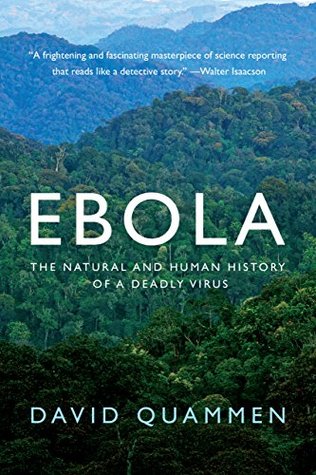
Book Review: 'Ebola: The Natural and Human History of a Deadly Virus' by David Quammen

For the last few months now our news cycles have always had a little snippet of Ebola news hidden somewhere between the wedding of George Clooney and a dog that got stuck up a tree. The only visuals are dusty hut, a dirty warehouse that is supposed to be a hospital and some people with paper face masks. And while it seems like a big story, you know that it is being downplayed because it is in Africa, still the dark continent in the 21st century. Yet the story has been there for months. Enough for some alarm bells to ring, hey this might be serious. But oh wait, Miley Cyrus just did something.
23305848
Usually by this time I'd be Googling Ebola, or buying a New Scientist with a special set of articles on the subject, but I haven't. But luckily I had a quick browse on NetGalley and came across this book. So I approached this volume hoping that all my curiosities would be quelled; what is Ebola exactly?  How is it transmitted? What effects does it have on the body? Where does it hide in it's downtime?

Were my questions answered? Not exactly. But through no fault of the author's at all.

I had no idea how little we know about Ebola. 

David starts his new book acknowledging that it is a rehash of a section from his previous book from 2012 'Spillover' that looks at zoonoses or an infection that is transmissible from animal to human. The majority of this book is not new material and is taken heavily from the aforementioned volume, but it has some small sections updated until early September 2014 regarding the new outbreaks. And while cynics will see this as a cash in on a new range of deaths I saw this as being far from it as it was an informative piece of writing that answered all the questions that it could regarding Ebola and introduced me to a writer who I had never read before and will probably go on to read in the near future.

The small book takes us through a short history of Ebola outbreaks ever since the first recorded outbreaks in the 1970s. It is also interspersed with a first hand account from David when he traveled through one region that had previously had outbreaks with a biological survey. So not only was the overview of the history of outbreaks fascinating, but it had personal stories from the people affected inbetween.


But the most astonishing aspect of the disease is how little is known about it for various reasons. When you have a virus that stays dormant for years in a non-human host, and then sudden outbreaks happen in the most remote places of Africa, where there are minimal survivors, and those that are infected die very quickly you have a very hard virus to study. Not only that but it is one of the most deadly viruses known and studies done with samples in laboratories require large amounts of risk minimisation and therefore large amounts of funding. So while a known set of symptoms are present the exact mechanism of how the virus interacts with the body still requires a great deal of work. It is known to devastate the patients immune system and also cause uneven clotting in the cardiovascular system so that clots appear in some areas while other bleed uncontrollably from the slightest rupture say of a needle.

David presents a short volume that is engrossing, horrific and truthful. I have come away with a much greater understanding of the complexities of the situation in these west-African countries and how their political and belief systems are exacerbating the situation. However I also know that the rest of the world could be putting in a greater effort and not dismissing it as yet another plight of the African or having undue panic and believing that it is a sign of the oncoming apocalypse. 

Thank you to Netgalley and Random House UK for a copy of this book to review.


Tuesday, 10 September 2013

Book Review: 'Gulp: Adventures on the Alimentary Canal' by Mary Roach

Mary Roach has written yet another winner here. Her early books "Bonk" and "Spook" were a little flat and derivative, but ever since then she has delivered.

Yes, she chooses deliberately risque subjects and yes there is always a chapter on farts, but damn she can make things interesting. It seems she can make the fine balance of making a scientist such as myself happy, while also placating my inner 8-year-old. And really, all she is doing by telling us how artificial farts are made, and the size of Elvis' colon is saving us time; I know I'd be looking up articles to see if anyone has gas chromatographed a fart after reading this. Mary has already done the Not Safe For Work googling for us.

Mary's books are great for everyone. You do not have to be a scientist to enjoy them, and you do not need to be an 8-year-old boy either. If you are a bit squeamish and delicate about bodily functions, read this, get over yourself and enjoy the wonderful piece of biology that you occupy.

So everyone, get out there and read some Mary Roach. You'll laugh, learn, be amazed and there will be plenty of WTFs. May we have many more wonderful Mary Roach adventures!


Saturday, 7 September 2013

DNA From The Elephant Man


From the BBC

From his death in 1890 and for most of the 20th century Joseph Merrick, otherwise known as the Elephant Man, was thought to have suffered from neurofibromatosis type 1, a disease upon which his case typified. However, research in the 1980s proposed that Merrick suffered from Proteus Syndrome instead and later research has questioned whether he was afflicted with both. It looked as if the syndrome Merrick defined was not the syndrome he may have had.

The early 2000s saw DNA testing on hair samples and bones samples that proved inconclusive due to the influence of preservation techniques. Professor Richard Trembath, vice-principal for health at Queen Mary University of London, and the custodian of Merrick's body explains the problem.

"The skeleton, which is well over a hundred years old now, is actually very clean. This represents a significant problem. On a number of occasions over the years the skeleton has been bleached during the preservation process. Bleach is not a good chemical to expose DNA to. It gives us an added problem in trying to extract sufficient quantities of DNA in order to undertake sequencing."

Currently, Dr Michael Simpson from King's College London is tackling the problem of extracting useful DNA from Merrick's bones.He is working on new techniques of DNA extraction from sample bones of the same age that have been bleached.

The hope is that new techniques can verify exactly what syndrome/s Merrick had and possibly discover a well documented case where the patient suffered from two in dependant syndromes.


Thursday, 29 August 2013

Do Octopi Have Distributed Intelligence?

Two thirds of octopi neurons lie outside the head and instead in the tentacles. The theory is that the cognitive load away from the head allows for and is a product of eight highly flexible and intricate limbs.

But how much intelligence is delocalised away from the head?

A resent study investigated the behaviour of severed octopi limbs and found that these limbs remain responsive to perceived danger long after being severed and the octopus owner has been euthanised. I feel I must address the ethics of this study and say that the animals were used in other unrelated previous studies and would have been euthanised regardless.

"After the animals were euthanized, their arms were removed and kept in chilled seawater for up to an

hour until they were ready for experimentation. Some arms were suspended vertically, and others were laid out horizontally. When pinched, suspended arms recoiled from the unpleasant stimulus by shortening and curling in a corkscrew shape within one second. (After this, the arms slowly relaxed and returned to their previous length.) Tap water and acid applied to the arms evoked a similar response. Horizontal arms also moved away from the undesirable stimuli, many bending in a sort of contrived joint toward the top.


 The authors of this study believe this is due to the tentacles containing nociceptors, neurons that respond to danger. In humans and most other vertebrates these cells are controlled by the spinal column, and a severed limb will not respond to dangerous stimuli.

Some experts are saying this is evidence of 'distributed intelligence', a theory that some animals with a large proportion of neurons not located in their head have thought processes distributed throughout the body. This theory is not limited to invertebrates, and other conglomerations of neurons have been postulated as 'second brains'. This has been postulated to have occurred in some sauropod species (from fossil evidence) and even a collection of neurons in the human stomach has been called a 'second brain'.

I guess it's all still at the theory stage still, albeit with some great evidence. One thing is for sure though, there is an increasing grey area when dealing with grey matter.

Link to the research paper.