Showing posts with label science. Show all posts

Monday, 27 October 2014

Book Review: 'Molecules: The Elements and the Architecture of Everything' by Theodore Gray

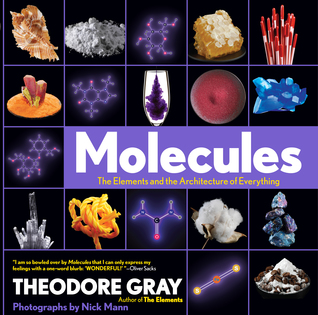
20729580Moving on from his wonderful books on DIY chemistry experiments (Theo Gray's Mad Science: Experiments You Can Do At Home - But Probably Shouldn't) and his glossy, beautiful and somewhat erotic (well us chemists get our kicks where we can) The Elements: A Visual Exploration of Every Known Atom in the Universe, Theo takes us a step up in complexity and deals with the realm of molecules in his latest glossy coffee table book to end all coffee table books.

Sure there is less structural narrative here than in 'The Elements' because we lack the periodic table, but the themes selected by Theo are great and do tie together somewhat. What you find are sections on soaps, sweeteners, dyes, aromatic compounds and a variety of others. Each section is contains the beautiful photography of Nick Mann as well as lots of structures and weird facts. 

Another aspect that I love about Theo's books are that I am not bored reading them and despite my wide reading and years of education and educating in chemistry there are still a variety of weird facts that I come across in his books. Admittedly I was a little bored in the first couple of chapters of 'Molecules' because it did lay down the foundations of what molecules are and how the atoms bond. But it is always great to read how another greatly intelligent person explains these basics to a non-educated audience. It is part of my job to do this for fresh faced university undergraduates. 


Yes I am possibly a bit biased being both a chemist and a big fan of Theodore's previous books but 'Molecules' kept me fascinated for hours and it is a book that I will revisit quite often. It may not be quite as catchy and as structured as 'The Elements', but close to perfection is still a commendable achievement.


Tuesday, 21 October 2014

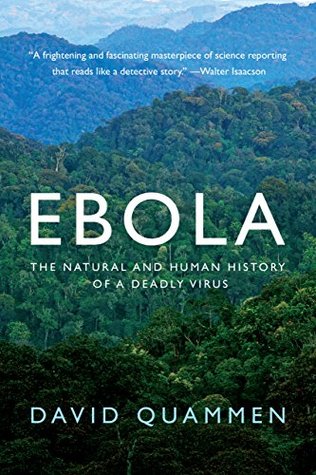
Book Review: 'Ebola: The Natural and Human History of a Deadly Virus' by David Quammen

For the last few months now our news cycles have always had a little snippet of Ebola news hidden somewhere between the wedding of George Clooney and a dog that got stuck up a tree. The only visuals are dusty hut, a dirty warehouse that is supposed to be a hospital and some people with paper face masks. And while it seems like a big story, you know that it is being downplayed because it is in Africa, still the dark continent in the 21st century. Yet the story has been there for months. Enough for some alarm bells to ring, hey this might be serious. But oh wait, Miley Cyrus just did something.
23305848
Usually by this time I'd be Googling Ebola, or buying a New Scientist with a special set of articles on the subject, but I haven't. But luckily I had a quick browse on NetGalley and came across this book. So I approached this volume hoping that all my curiosities would be quelled; what is Ebola exactly?  How is it transmitted? What effects does it have on the body? Where does it hide in it's downtime?

Were my questions answered? Not exactly. But through no fault of the author's at all.

I had no idea how little we know about Ebola. 

David starts his new book acknowledging that it is a rehash of a section from his previous book from 2012 'Spillover' that looks at zoonoses or an infection that is transmissible from animal to human. The majority of this book is not new material and is taken heavily from the aforementioned volume, but it has some small sections updated until early September 2014 regarding the new outbreaks. And while cynics will see this as a cash in on a new range of deaths I saw this as being far from it as it was an informative piece of writing that answered all the questions that it could regarding Ebola and introduced me to a writer who I had never read before and will probably go on to read in the near future.

The small book takes us through a short history of Ebola outbreaks ever since the first recorded outbreaks in the 1970s. It is also interspersed with a first hand account from David when he traveled through one region that had previously had outbreaks with a biological survey. So not only was the overview of the history of outbreaks fascinating, but it had personal stories from the people affected inbetween.


But the most astonishing aspect of the disease is how little is known about it for various reasons. When you have a virus that stays dormant for years in a non-human host, and then sudden outbreaks happen in the most remote places of Africa, where there are minimal survivors, and those that are infected die very quickly you have a very hard virus to study. Not only that but it is one of the most deadly viruses known and studies done with samples in laboratories require large amounts of risk minimisation and therefore large amounts of funding. So while a known set of symptoms are present the exact mechanism of how the virus interacts with the body still requires a great deal of work. It is known to devastate the patients immune system and also cause uneven clotting in the cardiovascular system so that clots appear in some areas while other bleed uncontrollably from the slightest rupture say of a needle.

David presents a short volume that is engrossing, horrific and truthful. I have come away with a much greater understanding of the complexities of the situation in these west-African countries and how their political and belief systems are exacerbating the situation. However I also know that the rest of the world could be putting in a greater effort and not dismissing it as yet another plight of the African or having undue panic and believing that it is a sign of the oncoming apocalypse. 

Thank you to Netgalley and Random House UK for a copy of this book to review.


Wednesday, 23 April 2014

Someone's taking the Piss

In the early morning of the 16th of April a teenager from Portland in the U.S. drunkenly peed into one of the city's drinking water reservoirs. The trouble is that he did it in front of a security camera and this footage has gone public. The city's solution: drain and dump 145 million litres of drinkable water. 

A spokesperson from the governing body stated that it was understood that there was no risk from the urine but it was decided to dump the water due to the public's "perceived difference"or as I like to call it "ignorance".


This action is unimaginably wasteful and pandering to the lowest common denominator. Take a look at this reservoir or indeed any reservoir. Dead animals, algae, rubbish, particulates. Are we really worried about that amount of pee?

Lets do some quick calculations.

Wikipedia states that most bladders hold between 500 - 1000 mL. Lets go for the worst possible scenario and say 1L of pee went in. So essentially the the pee is diluted 145 million times. Or if you take a glass of this water, you may drink 1.7 nanolitres of this guys piss. You probably drink a larger volume of your own pee after you go to the toilet, wash your hands and eat something from your hands.


Friday, 7 March 2014

Book Review: 'You Are Not So Smart' by David McRaney

This great work boils down to: "Despite millions of years of evolution your brain is a jumbled mess of neurons that covers up it's downfalls by lying to you constantly. Here are just 46 ways your brain is being an asshole."

Just like Dawkins argues against a creator in showing that evolutionary adaptations can be flawed and seemingly badly designed, David McRaney shows in this work that despite those claims that the human mind is one of the most complex structures in the known universe, it's shoddily put together, with bits that don't work together and bits that were added on at the last minute and that the only way it 'works' is that it constantly lies to itself about the reality it exists in. You have in your head a used car salesman.

David demonstrates the limitations of our brains by picking out these 46 different ways our brain lies to us and writing a small chapter on each. Each lie is well researched and refers to different published studies for evidence. For example the chapter on why you have too many Facebook friends talks about studies about the limitations of how many people you can hold in a social circle in the physical world and compares these figures to the data on Facebook. He also talks about the reason why you 'befriend' all those people using the internet.

Most interesting are the chapters that highlight the limitations in vision and the comprehension of sensory input. You are not a little person in a box watching a ultra high definition surround sound movie of your existence. More like your homonculus watches a scratchy silent movie from 1908 with no sound and missing film cells, a friend tells them about the soundtrack over the phone.

There are also great chapters on how you think you are better than everyone else out there. He actually gives statistics on how many people think they are better than average drivers and how many people think they have a better than average IQ. The figures will astound you.

I highly recommend this fun and enlightening read. It certainly will make you question everything you think and perceive, which is a practice that all science endorses strongly. This book is so much more than your average pop-psychology book that litters the popular science section of bookshops and libraries. It holds no punches and approaches the subject from a critical standpoint. Weeks after reading this book I'm still laughing at my brain when I know it's lying to me.


Wednesday, 26 February 2014

The Oldest Rocks on Earth

At 200 X 400 micrometres this zircon crystal extends the limits of our understanding of early Earth back to 4.4 billion years ago, a mere 100 million years after the Earth was formed and only 160 million years after the Solar System formed. This discovery pushes back the date for when Earth first had a solid crust and weakens the theory that at this time the Earth was hot and entirely molten. It seems the conditions were much milder much earlier than we thought. There are two methods of dating these minerals, via radioactive dating methods and using atom probe tomography. The research group who dated this sample used atom probe tomography, but I am going to talk about radioactive dating methods.

Zircon crystals are brilliant for radioactive dating because of two reasons. Firstly they're tough, they last a long time and can withstand an amount of tectonic pressures. Secondly, and most importantly, they form with radioactive uranium in their structures AND they do not form with lead in their structures. Why is this significant?  Radioactive uranium degrades into lead. So we can say that any lead present in the crystal is due to the decay of the uranium and nothing else. Zircon crystals are special in another way. They form with two different radioactive isotopes of uranium which both degrade at their own independent rates into two differing isotopes of lead.

Radioactive decay happens with precise timing. We know how radioactive decay works and at what rate it happens at. It's an exponential decay that is as regular as clockwork. Whether this happens over billions of year, hours, minutes or microseconds, all radioactivity follows exponential decay that is given in a simple mathematical expression.

So essentially zircon crystals are like clocks that were set to zero when they solidify from molten rock. Actually more like two individual clocks in each crystal because of the two different radioactive decays. All we need to do is to look at the ratio of uranium to lead to tell what time it is, just like looking at the two hands of an analogue clock. And the beauty is that we have two clocks running simultaneously and confirming each other.

So you start off at time zero with 100% of the parent isotope. This degrades at an exponential rate to a daughter isotope. For example:


We can say how fast each radioactive decay occurs by a concept called 'half-life'. A half-life is defined as the time when half the amount of the parent isotope has decayed into the daughter isotope. So at time zero there is 100% parent isotope and at the half-life there is 50% parent isotope and 50% daughter isotope. And because this decay is exponential, at 2 times the length of the half-life the parent isotope is at 25% and the daughter at 75% and so on.


Each radioactive decay happens at its own rate. For example the half-life of uranium-235 is 704 million years, the half-life of uranium-238 is 4.5 billion years, while ruthenium-106 is 1 year, carbon-11 is 20 minutes and lithium-12 is 10 nanoseconds. So for the two uranium decays in zircon you can see that the decay from uranium-235 happens at a much faster rate than that of uranium-238.

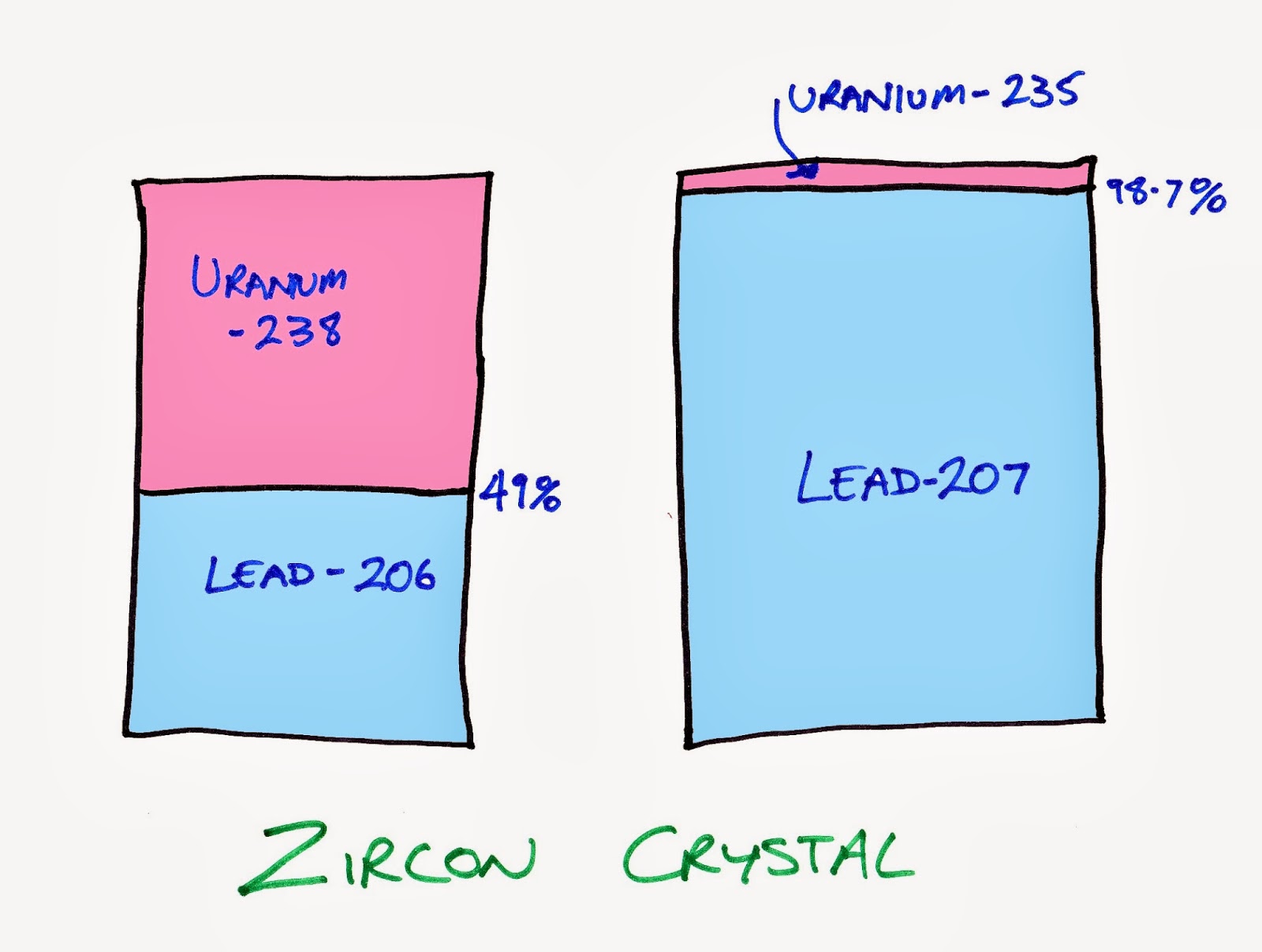
Scientists trying to age a zircon crystal look at how much of uranium-238 versus lead-206 there is and how much uranium -235 versus lead-207.


You can use these ratios to back calculate ages of the crystal. Looking at uranium-238 there is nearly a 50-50 mix of parent to daughter isotopes, so therefore it is just under the age of its half-life of 4.5 billion years. With the uranium-235 you can see that most of it has decayed to lead-207 and there isn't much uranium left at all. It has gone through many half lives. In fact we can calculate it has gone through 6.25 half-lives and 6.25 multiplied by 704 million years is 4.4 billion years. So you can see how the correlation of the ages calculated of these isotopes are a powerful tool with both results pointing to 4.4 billion years or so.

The same method of looking at the ratio of parent to daughter isotopes is used for all radioactive dating. The other type of dating that you may have heard of is radiocarbon dating or carbon-14 dating. This method looks at the amount of carbon-14 in a sample which could be some bones of animals or humans or trees or other living things. Because all living things have a large amount of carbon in them, some of the carbon is naturally occurring carbon-14 (as opposed to the normal carbon-12). When a living thing dies it does not absorb any more carbon into its system and the carbon-14 that remains decays. So the amount of carbon-14 left in a biological sample tells us how long ago it died. The half-life of carbon-14 is 5,730 years and so if we find half the expected carbon-14 in a sample is must be around the age of 5,730 years. This method is limited to around 60,000 years or 10 or so half-lives. After this time there is only 0.1% of the parent isotope left and the error becomes too large to be reliably date a sample.

So you can see how radioactive decay is a useful tool to date objects. You cannot use every type of radioactive decay out there to age objects, it is limited to systems where you know the concentration of one isotope at time zero. But luckily there are several systems where this occurs and knowing this fact gives us a glimpse into the distant past.

Just for the hell of it here is a zircon crystal from my own collection. It's probably nowhere near as old as 4 billion years as it is large and was from a location in the Northern Territory that is not renowned for it's age.

Friday, 20 December 2013

Book Review: 'Shaman' by Kim Stanley Robinson

Kim Stanley Robinson's new novel may seem like a change from his past works, but in a way it fits in well with his other works. Instead of spaceships we get the end of the last ice age. And although you may think that this is a huge change in what Kim usually writes, we do get a story about humans surviving and adapting through innovation and investigation, just like all of his stories. 'Galileo's Dream' may have seemed like Kim was talking about the beginnings of science, but with 'Shaman' he shows that there are no beginnings of science and that it is essentially part of being human.

Kim has stated that his inspiration for this novel come from extensive hiking near glaciers and the type of environments that Europe would have been like at the end of the last ice age. On these hikes Kim would imagine what it would have been like to be a human at this time. Other inspiration has come from the ongoing investigation of Otzi, the five and a half thousand year old body found exposed in a glacier in 1991. Clothes and other artifacts found with the body have survived wonderfully and provide a great insight into the technology and innovation of the time.

What Kim produces is a heart-warming, coming of age tale of an apprentice shaman. We join him in his first wandering, cast aside into the wilderness naked and with no tools. We learn an awful lot about his clan and how they function in day to day life. And every character you encounter is well-drawn and is a complete individual. These people and the book itself does well to remove itself from using the standard caveman stereotype and indeed shows that 'humanity' has been with us all along and did not come about with the rise of civilisation.

I found that I did not enjoy this novel as much as some of Kim's other works such as the Mars trilogy and 'Galileo's Dream', but compared to most other works out there, it is still a brilliant and thoughtful work full of wonder and heart. In my opinion even when Kim is experimenting and trying something different like this, he could write the pants off all but a few authors.


Monday, 16 December 2013

Returning to the Moon


So I have been absent for a few weeks from the blog. Well, at least I didn't abandon you all like we did to the moon. Thanks to China, after 37 years we have finally put another craft on the surface of the moon. The Chang'e-3 lander contained a rover called Yutu, or Jade Rabbit in Chinese. After a landing on Saturday everything seems to be go for the little rover.

The rover has a twofold mission; to explore the landing area, the dark lava plains of Bay of Rainbows in the north of Mare Ibrium, as well as deploying a telescope on the surface. The Bay of Rainbows has piqued the interests of the China National Space Agency due to its geological features. Investigation of the lava plains will lead to greater insights into the history of the moon, from when there was volcanic activity on the surface. These lava flows are presumed to have left behind lava tubes, as occurs in lava flows on Earth. Lava tubes are formed by hotter flowing lava accumulating in channels that run through cooled lava. These tunnels can be small, about 100 mm diameter, up to very large tunnels several metres in diameter. I recently visited one at Mount Kilauea, Hawaii that was large enough to take a leisurely stroll through.


These structures under the lunar surface would be perfect for future human settlement as they will easily convert to a sealed environment, with the benefit of having radiation deflecting rock above. The lack of atmosphere on the moon allows for all radiation from the sun to contact the surface; a very dangerous long-term environment for any life. The importance of finding and exploring these structures is important to future space efforts.

To aid in this underground investigation, the rover carries a ground penetrating radar system, estimated to be able to detect structural changes down to about 150m below the lunar surface. The rover also carries a scoop with a spectrometer to analyse lunar regolith samples.


Deploying a telescope on the moon is of great interest to astronomers due to the lack of atmosphere, the same reason why the Hubble telescope was so successful also. Looking through an constantly shifting atmosphere at distant stars can prove to have its difficulties.  The lander also carries an ultraviolet camera in the aim of photographing the Earth's plasmasphere, a distant part of the atmosphere where the Earth's magnetic field deflects incoming radiation from the sun. Although the plasmasphere has been mapped before, it has only been mapped from within. The new photographs will confirm the structure of the plasmasphere from the outside.

The new rover is part of the beginning of China's space program. Previously two orbiters have been successfully launched by the program, and there are plans for many more including a mission to return rock and regolith samples back to Earth in 2017. With South Korea and other countries also initiating space programs in the last year, it is definitely an exciting time for humanity. The collaborative efforts of space exploration are proving to be beyond politics. It's time to be optimistic about our futures.

Sunday, 17 November 2013

Book Review: "Feynman" by Jim Ottaviani and Leland Myrick

I have been slow to discover the delights of Feynman, but I recognise a similar thinker, albeit a much, much brighter man. I love his famous BBC interview that was towards the end of his life and I did greatly enjoy his autobiographical sections in "Six Easy Pieces".

A graphic novel adaptation of Feynam's life works very well. While it does not present any new material, it takes the best snippets from all different sources and makes his life come alive with wonderful and simple illustration. Another great advantage to this medium is that the authors presented sections of Feynman lecturing and explaining physics problems. This works wonderfully and could only be bettered by watching a video of these lectures. (You can find some of his filmed lectures on Youtube).

So this was a wonderful read for a rainy Sunday afternoon. It really did capture his voice and his philosophies if I could use that term.


Saturday, 16 November 2013

Library Copy of 'Fifty Shades of Grey" Tests Positive For Herpes


For a laugh two Belgian toxicologists borrowed 10 books from their local public library and put them through toxicological and bacteriological screenings. What they found was quite intriguing.

All books were rife with bacteria. Well that should be a no-brainer, but did they run some background readings on other books, say from their own library?

Another finding was that all showed trace amounts of cocaine. Not enough for a reader to display physiological symptoms, but possibly enough to alert a drug screening.

Also, "Fifty Shades of Grey" tested positive for the Herpes virus. Very low amounts mind you and the experts say not enough to transmit the virus. But what if you have a suppressed immune system?

Anyway, support your local libraries, they do great work. Keep your cocaine away from the books though. And anyone borrowing "Fifty Shades" from the library, well you deserve what you get.

Source: http://www.deredactie.be/cm/vrtnieuws.english/News/131112_50Shades

Friday, 8 November 2013

Book Review: "Heretics: Adventures with the Enemies of Science" by Will Storr

In my mind Will Storr is the brilliant love-child of Mary Roach and Louis Theroux, both of whom I adore. I think Will may have to join their lofty heights in my respectability/adoration mind shrine.

Will's "Will Storr vs the Supernatural" was a wonderful and random find that I made several years ago. Will took it upon himself, Louis Theroux style, to get immersed in the lore and activity of the supernatural. What was different about the other supernatural books is that Will approached it from a skeptical point of view. His conclusions were  that most of what he investigated was utter bullshit, but there were a few instances that made him think. That book was much better than Mary Roach's approach taken in her book "Spook".

Anyway, this time Will has taken on the enemies of science. Well more like the enemies of reason. SO each chapter or two is dedicated to an interview or an activity with a fringe group or person. You start with a creationist preacher, move through to holocaust deniers and take on homeopathy. All sections are well-researched and Will approaches each instance with a sympathetic ear. That ear may not last long, but he does have the best of intentions.

All throughout Will is bringing this all back to the nature of belief and the apparent need for the human brain to make reliable sense of the world it exists in. So there is a greater message other than "Look at these dickheads" and a great attempt to try and understand human thought processes.

In it's own way I think that this book adds it's own to a religion vs. science argument and should be considered essential reading for anyone tackling this subject. It definitely should be as popular and as read as Dawkins' "The God Delusion" and makes a much more logical assay of belief than Hitchens' "God is Not Great". It had a die-hard atheist like myself thinking as opposed to going "right on!" to every point.


Saturday, 26 October 2013

A Day in the Life of a Seagull


Dutch researchers attached a GPS to a female seagull to track her travels during a day. The video animation is the result of the data collected.  332 km were covered during the day.

I'm still not giving them my chips.

Thursday, 24 October 2013

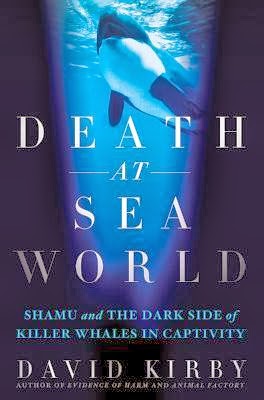
Book Review: 'Death at SeaWorld: Shamu and the Dark Side of Killer Whales in Captivity' by David Kirby

'Death at Seaworld' is a fascinating and meticulously researched work that centres upon the death of a killer whale trainer at the U.S. theme park in 2010. However the work also takes on the entire history of the captivity of these whales, as well as research undertaken in the wild.
What you get to read may be argued as one-sided as it argues strictly against the captivity of killer whales, but with the evidence presented, there is no other conclusion that could be reached. It does essentially come down to animals performing under extreme duress for the pleasure of humans to bring in dollars.

There is a lot of focus on policy and politics about marine mammals in the U.S., but it never gets bogged down in too much detail, and the people who played a part in these affairs are well-drawn and interesting people in their own right.

An interesting section looks at the plight of Keiko, the star of the 'Free Willy' movie. Keiko was hired from a Mexican animal park to star in the movie. The conditions that he was in were dismal with a very small concrete tank, that was so shallow that his pectoral fins always touched the bottom and had lesions on them. The tale of his journey being an experimental re-release into the wild is a wonderful and enlightening story.

I guess what also sets this work apart from the usual anti-captivity arguments is that it is strictly about killer whales. The author does make an argument for captivity of certain species for educational and conservationist purposes. He is not a die-hard anti-this anti-that person. The argument put forward is strictly about this species and it's conditions and treatment in captivity.

So if you are a bit of a zoological nut check this book out. I highly recommend it.


Thursday, 19 September 2013

Don't Touch Lizzy, You Don't Know Where She's Been


From New Scientist

Just as the Bank of England announced it was considering phasing in plastic pound notes in 2016 a study announces the fact that some bacteria tend to survive for longer on plastic than other currencies.

Habip Gedik at the Okmeydani Training and Research Hospital in Istanbul, Turkey, placed bacteria such as E.coli on differing currencies (the euro, US dollar, Canadian dollar, Moroccan dirham, Croatian kuna, Romanian leu and Indian rupee) and had volunteers handle these notes. The time between dosing the dosh with bacteria and handling was differed.

The best anti-bacterial notes was the euro, with the U.S money coming up second. The worst was the Romanian leu, with a large amount of bacteria being transferred to the handler after the most amount of time. The Romanian leu is similar to the New Zealand and Australian notes and we should all beware.

Still, it's probably less bacteria than the amount on your keyboard right now.

"I was amazed to see that some currencies act like breeding grounds for bacteria while others seem to be auto-sterilised," says team member Andreas Voss of Radboud University Nijmegen in the Netherlands.

Tuesday, 17 September 2013

Book Review: 'Galileo's Dream' by Kim Stanley Robinson

I finally braved getting this large tome out of my to-read-pile. It's not that it scared me, I have pretty much adored all that I have read of Kim's, it's just that I'm busy researching at the moment and I knew that this would eat up my time and imagination. And it did, but it did not interfere with my work at all. I'm glad I pulled it out. It really was the best book at the best time.

'Galileo's Dream', although being fiction, is 70% biographical. The story is essentially Galileo's life from his work on telescopes up until his death. We see him rise to fame for his mathematical work and his work with telescopes, his writings on the Copernican universe, and his downfall and judgement by the Catholic Church.

Interspersed in this non-fiction are little snippets of fiction that Kim has placed in Galileo's story. Each section fits into the truth so well and mirrors excerpts from Galileo's writing. As to what they involve, well you'll have to read it yourself; but Kim is a science fiction writer at best.

Just like Galileo the book is intelligent and funny with a great amount of detail being given on politics and his everyday life. Each character is unique and you get to experience many wonderful personalities. The imagery in this book is wonderful, sumptuous and beautiful, full of the observations of an early scientist.

At the heart of the story is the story of science and one of it's founding giants, a man who connected what he could see and observe to mathematics, and looked to see if these results were repeatable and consistent. The fiction of the story is a further exploration of science and philosophy which is powerful and a great enough story in itself.

This really is a wonderful work which gives me a great respect for Galileo and has encouraged me to read further into his story and see how much the details in the book are true. Kim has risen to new greats in my respect also. This one one of those rare treasures of a book that spoke volumes to both my mind and my heart. It would definitely be in a top 20 book list of mine and may even make it to a top 10. It deserves all 5 of those elephants.

Book Review: 'My Brief History' by Stephen Hawking

Thanks to Netgalley.com and Random House Publishing Group for a review copy in exchange for an honest review.

I have never read  any Hawking before *gasp*, so what a place to start, on his autobiography. Titled 'My Brief History' is really is brief and to the point.

The style of this autobiography is terse, to the point, and mainly about his academic achievements. His children and wives get a brief mention, which is reassuring, with the only other personal story being that of the onset of his disability and the management of it. Which is also brief in comparison to the rest of the story.

I have thought about why this style may have come about and I have several theories, each may play a role. Foremost, he is a scientist, and has given us the facts of his life. There was no embellishment, because scientists don't tend to go for all that touchy-feely stuff.

It takes a lot of effort for Stephen to write. He says explicitly that he manages three or four words per minute using his speech system. This short autobiography translates to many hours of work. Give the guy a break.

He is a private guy, and would prefer not to have all his washing hung out. Although you do get snippets now and then. For instance, when he thought he was dying in the 70s and his children were young, he and his wife decided upon a future father and husband after he was gone. The man that was selected moved in to get better acquainted with the children. Stephen's condition did not go according to what the doctors predicted and months later his marriage was over. It is obvious he did this out of love for his wife and children. It is tragic as to how it turned out.

The closest autobiography in style to this that comes to mind is Roald Dahl's 'Boy' and 'Going Solo'. Both authors give brief tales that are full of facts and not much feelings.

So a nice quick read that gives us a look at the personality and work that the amazing man has done over the last 50 or so years. Just be careful about your expectations of what this autobiography will give you. It will not give you an in depth warts and all account of his whole life. But still well worth the read if you are a fan or a fellow scientist interested in how famous academics live and research. It has given me the inspiration to move his other works up my to-read list.


Saturday, 14 September 2013

Book Review: 'A Universe From Nothing' by Lawrence M. Krauss

I guess everyone could have predicted that I would give this book 4.5 stars, if not at least agree with it's theories. Being a forthright atheist and scientist I was bound to love this book right? Well that argument could be made, but I refer you to my ratings for other atheist works such as "The God Delusion", which I must admit deserves a reread and possibly an updated higher score in retrospect, and Hitchens' "God is Not Great" which I thought was relatively poorly argued due to being essentially "look at all these bad things that religion makes people do", which anyone with any education will conclude with "no shit Hitch, but what about whether God could and may exist?".

But this book isn't really an atheist agenda, as it only answers the question of how a universe could come into existence from nothing, no energy, no trigger, no cause. This is a question I ask as a scientist an non-believer, but it also gives an answer that happens to contradict most theological thought. Coincidence? Well I guess most theories based upon the observed data over the last few centuries have done this and in effect God has been pushed further and further away until has has been left with the role of the spark. Now Lawrence is taking away that role and it pisses people off.

I guess that even though 95% of this book is purely cosmological with the only agenda is to illuminate, it is hard to not go into a science vs theology argument here as the reviews for this book on Goodreads.com, and I would surmise "The God Delusion" follow a similar pattern. 

Poor reviews for this book tend to fit into the categories:
* I did not get it (it was written with too much jargon and with a steep learning curve)
* People who are offended that he had a go at philosophers.
* Religious people who tend to say "While the cosmology was interesting his conclusions were ill-found and the afterword by Richard Dawkins was just offensive."

I guess you could also argue that good reviews tend to be from scientists and atheists.

So despite being one of the best atheist arguments I have read in print, it is not going to achieve any change at all in the religious 'head-in-the-sand' type. If you are religious, don't read this book. Don't try and argue against it as you will look the fool. If you are an atheist or a scientist give it a go. It is a hard slog in sections, but it is rewarding.

I adored this book as it educated, enlightened and reconfirmed the power of science and reason.


Voyager Has Left the Solar System. No Seriously, This Time It's True.


So yet again comes the news that Voyager has left the Solar System. But this time it's a bit more reassuring as it comes from NASA itself.

But you could not be faulted for believing over the last couple of years that:
  • Voyager is lost and too masculine to ask for directions.
  • The edge of the solar system consists of a series of alternating stripes of Solar System and Non-Solar System.
  • Spacetime is curved.to a massive degree.
  • No one has any fucking idea where the Solar System starts and when it ends.
The last one is the closest. It seems that there are differing definitions upon what should constitute the edge of the solar system and these guesses end up being not so easy to be defined and measured.

I guess it's kind of like saying "Today a certain molecule of water passed from the Indian Ocean to the Atlantic Ocean". Sure these oceans have their own currents, differing salinity levels, temperatures, etc so how would you define an edge between them both? Say there was a major difference in salinities, where would you define the boundary? The average value of salinity content between the two? Sounds like a great idea but this will not give one definite line (an isosaline?) between Africa and Antarctica.

Back to space and we start defining regions by the density of ions, plasmas and the presence of magnetic fields. The main area around the Solar System is defined as the heliosphere, where the Sun's magnetic influence is strong and the area is streamed with charged ions from the sun.


Beyond the heliosphere is interstellar space, where the suns magnetic and ion influence drops almost altogether, and a high concentration of interstellar plasma takes over. The transition happens over a wide concentration gradient called the heliopause. 

Looking back upon readings from August, NASA confirms a change in magnetic influence on the craft and a much greater concentration of plasma in the surroundings. I guess that NASA has made the calling that Voyager is in the latter of the heliopause if not in interstellar space. It just goes to show, definitions are hard to make.

Tuesday, 10 September 2013

Book Review: 'Gulp: Adventures on the Alimentary Canal' by Mary Roach

Mary Roach has written yet another winner here. Her early books "Bonk" and "Spook" were a little flat and derivative, but ever since then she has delivered.

Yes, she chooses deliberately risque subjects and yes there is always a chapter on farts, but damn she can make things interesting. It seems she can make the fine balance of making a scientist such as myself happy, while also placating my inner 8-year-old. And really, all she is doing by telling us how artificial farts are made, and the size of Elvis' colon is saving us time; I know I'd be looking up articles to see if anyone has gas chromatographed a fart after reading this. Mary has already done the Not Safe For Work googling for us.

Mary's books are great for everyone. You do not have to be a scientist to enjoy them, and you do not need to be an 8-year-old boy either. If you are a bit squeamish and delicate about bodily functions, read this, get over yourself and enjoy the wonderful piece of biology that you occupy.

So everyone, get out there and read some Mary Roach. You'll laugh, learn, be amazed and there will be plenty of WTFs. May we have many more wonderful Mary Roach adventures!


Sunday, 8 September 2013

Worlds Largest Volcano Discovered Under the Pacific Ocean

Confirming the old saying that we know more about other planets than what is happening on the ocean floor, geologists announced this week that Earth's largest volcano is under the Pacific, to the east of Japan.
Don't get me wrong, these guys didn't just stumble upon a huge active volcano while on an underwater stroll. The area known as Tamu Massif was previously thought to have been a series of volcanoes, just like Hawaii and Iceland,  instead of what has turned out to be one significantly large volcano. Oh and don't worry about activity. The area was formed 145 million years ago and went extinct quite soon after. So while plesiosaurs would have been freaked out by it, there is no need for you to be.


William Sager of the University of Houston headed this 15 year study which composed of a large series of sonar mapping and drill cores concluded that all flows in the area originated from one source and not several as a series of volcanoes would present. Sager states: "Before this we weren't sure that we had single volcanoes that could grow to this size. Now we do."

The world’s biggest active shield volcano, Mauna Loa on Hawaii, has an areal footprint just 15% of Tamu’s — but Mauna Loa is taller, rising 9 kilometres from sea floor to summit.


The knowledge that volcanoes this large can and have formed on Earth previously has led researchers to rethink and reassess whether other presumed series of extinct volcanoes may actually be large singular volcanoes as well.  Sager believes another candidate may be the Ontong Java plateau east of the Solomon Islands, which has similar features to the Tamu Massif. "It's being investigated by Japanese researchers," he says, "so the Tamu Massif might not be the last word."

Saturday, 7 September 2013

Climate Change Reveals Ancient Norwegian Artifacts

Original article from Antquity

Rapid climate change has been a boon for archaeologists in cold climates. Each year more and more ice is melting and revealing artifacts Bronze Age artifacts. The most famous case of this being the revealing of Otzi, a preserved Bronze Age man found in the Swiss/Italian Alps approximately twenty years ago.

Recent finds from record snow melts in Norway have revealed other interesting artifacts. This tunic was found exposed on the Lendbreen glacier, bleached by sunlight and wind exposure. It is made from lamb's and sheep wool with signs of patchwork and repair. It has been dated to 230-290 AD.

A set of arrowheads were found in a snowbank nearby that are dated to 6000 years old. The author of the paper writes:

"The number and antiquity of some of these artefacts is unprecedented in the almost century-long history of snow patch surveying in the region. At the same time, as the climate continues to heat up and the snows melt away, one wonders what long-term price there will be to pay for these glimpses of the frozen past."