Saturday, 8 February 2014

Scalzi's 'Redshirts' Coming to Television

It is reported that Scalzi's wonderfully clever book 'Redshirts' is being adapted for television by FX (some US cable company). This is absolutely great news and hopefully it is done faithfully to the book.

The story of 'Redshirts' is a direct satire of Star Trek, where unimportant Redshirts get killed very often, yet senior officers seem invincible. A group of the Redshirts notice this and start plotting and investigating. A great story ensues.

I hope these guys have a great legal team as who knows how Paramount, the company that owns Star Trek, may want to act about it.


Book Review: 'On The Map' by Simon Garfield

Who here loves maps and can pore over a map of an unknown territory, real or fictional, for hours imagining the geography and the adventures to be had? Yeah you are one of those people, a lot of us are. In fact I'd hazard to say that a majority of geeks and nerds are. It's part of who we are and a natural expression of our imagination and deep passion for things.

In the last couple of years there has been a few books about maps starting to be published. It seems that we are all rediscovering our childhoods love of the atlas and also discovering that we weren't the weird outsider we thought we were. The last book on maps I read was a beauty, 'Maphead' by the wonderfully hilarious Ken Jennings (see my review on goodreads.com). Ken takes a look at several applications of mapping in the last few decades and engages with these activities, interviews people involved and just has a lot of fun.

'On the Map' provides a different and more traditional look at maps by presenting a chronological history of cartography via selected maps, or mapping techniques. Simon takes us on a journey from the very first attempts at mapping the known world, the Mappa Mundi, right through to GPS systems and mapping in video games.

It's hard not to compare Simon's work with Jennings' even though they take a different perspective upon the subject and do compliment each other. There were some points where I felt a little let down by Simon, but I'll get to those points after, because despite these, it was a damn good read. Simon has chosen by far some very interesting tales to tell about the history of cartography, and it seems he has done a great deal of research. Each chapter is clear and concise and very entertaining. It is clear that Simon is a great fan of maps and is enthusiastic to share.

But onto those niggling negatives, and there are only two. Firstly, there is a chapter on mapping in video games that is quite well-researched and he admits that the maps and geography in these games are intricate and the effort that goes into these works is astounding. Yet he writes derisively about these games being time wasters and infers that people who play these games are on the fringe of society. Surely he has heard of leisure activities and that normal people play these games not just unemployed stoners. Anyway, being a bit of a gamer, especially a fan of sandbox games, where mapping and geography get expressed in the most beautiful ways, I felt disappointed  that Simon did not express a greater understanding and appreciation of these points.

Secondly, there were instances when Simon interviewed  a person about a subject that he was writing about and mentions going to meet this person etc. But sometimes there was no more information about this meeting or person for more than a paragraph. I am supposing that most of what he talked to the person about made it into the text as pure information, but it seemed like that in a few instances I would have liked to have heard more from that person and about that person. I know I have written a lot about these negatives, but they are very small.

I purchased this book without looking at a single review and it was a great surprise that it was so good. I don't often purchase books blindly these days. Part of the motivation was that a few weeks previously I had visited a great exhibition of maps in Canberra (National Library for all the Australians. Go see it!). It was a great surprise to have a major part of a chapter about one of the highlights of that exhibition, the Fra Mauro world map, an imposing approx 3m X 3m intricately detailed 15th century map.


So Simon has produced a wonderful work that expresses deep love for the subject. It is both a fun and informative read that is also well-written. I'd recommend this book for anyone who loves maps. Yes you!


Saturday, 1 February 2014

Book Review: 'The Knowledge: How to Rebuild Our World From Scratch' by Lewis Dartnell

Thank you to both Netgalley and Random House UK for an advance reader copy in exchange for an honest review. 

If someone came up to me and said "Hi, here is an instruction manual to rebuild civilisation after collapse. You're welcome!" guess how I'd react. There would be sarcasm and the little wizened skeptic that lives in my head would be having a field day. And I did approach this volume with an amount of skepticism. How can you boil down all of civilisation into one 250 page volume?

Being a fan of post-apocalyptic fiction I am no stranger to the thought experiment. The first 'grown-up' book I ever read was John Wyndham's 'Day of the Triffids'. My older sister was assigned this novel to read in high school and complained about a stupid novel in which stupid plants come to life and kill everyone. Not ideal for a thirteen year old girl, ideal for a eleven year old boy. Ever since then I have had a soft spot for apocalyptic fiction with stand-out favourites being 'Earth Abides', 'The Walking Dead' comics and the other works of Wyndham. So I have been part of this thought experiment for a while now.

And as my education has furthered into the sciences and gone into research, my environmentalism has increased and the knowledge of human activity with respect to the stability of the climate has caused these thought experiments to become more of a possible future reality. I believe it is within the realm of possibility that civilisation as we know it could collapse during my lifetime. The more I learn, the more I realise it would not take much at all to tip the scales into a decline in drastic decline in living standards.

It's obvious that Lewis has thought extensively on this also. But he is infinitely more talented and had set himself the task to write an instruction manual to reboot civilisation. And despite approaching this work with complete skepticism, I come out the other side amazed and completely humbled by this work and it's author. Lewis has achieved exactly what he has set out to do. This is a work that I would want in my hands in an apocalypse. The irony being that I have read this reviewer copy as an e-book, the most inaccessible method of transmission of data in a coming apocalypse. A part of me even feels that paper might not be robust enough nor last long enough to hold this wisdom.  I'd sleep better at night knowing that this was reproduced in stone buried in a sealed crypt somewhere far from any cities.

What Lewis offers isn't a complete set of instructions (but some methods are described in great detail), but rather an overview of differing technologies such as agriculture, food preservation, basic and advanced chemistry, communications and more with specific methods and examples of the history of certain technologies and how to reboot these technologies from scratch. And Lewis admits that reproducing the historical progression of science and technology is not the most efficient reboot scenario, and that just having certain knowledge can hopefully leapfrog past certain stages and methods. He even suggests that several technologies that were adopted were inferior to abandoned competitors in hindsight and that a new civilisation should take advantage of this hindsight.

Lewis' writing is succinct,accurate and informative. His ability to refine a concept down to one or two sentences that manages to convey exactly how a thing works and why it does what it does is astounding. This is what all educators and science communicators strive for and it seems like he as a great talent. When he was explaining concepts that I have previously learnt I was amazed at the clarity of which he would convey the ideas. How easily can you explain how refrigerators work using the laws if thermodynamics?

What Lewis presents is truly an astounding work that actually does have the potential to achieve what it set out to do. I'd recommend this book for not only any post-apocalyptic fan, but anyone interested in science, technology and any curious person who likes to know why things work. I am now an instant fan of Lewis' and I look forward to the publication of this book in April 2014. I'll at least be buying a paper copy.


Wednesday, 1 January 2014

Book Review: 'This Thing of Darkness' by Harry Thompson

'This Thing of Darkness' tells the story of Robert FitzRoy, brilliant naval man, father of meteorology and friend of Charles Darwin.This is technically a fictional account of his life, but it really is a novel written around factual sources from FitzRoy's logs, Darwin's writings and other historical data. Thompson has written a magnificent character piece around this historical data.Thompson goes on to write an afterword that outlines exactly how little he embellished the story, in most instances only inventing the dialogue, and highlights a very few scenes which were entirely fabricated.

The one aspect that stood out was the quality of the dialogue. Each conversation was interesting and insightful. It was at times quite hilarious. For a book about the tragic life of FitzRoy, there are some great laughs. And we all know how hard it is to write comedy in a novel. There is a wonderful scene with the Beagle's surgeon and a parrot that will make you laugh out loud.

This wonderful book kept me occupied during the holiday period. It was a shame it had to end. It really did tick all the boxes for a perfect novel. Lots of science, learning, history, comedy, tragedy and all told with a lot of heart. It is truly deserving of the highest marks I could give and would make it into my selected top 10 reads of all time. This is a book recommended to everyone, especially those who would like to know more about Darwin and FitzRoy without wading into dull history books.


Friday, 20 December 2013

Book Review: 'Shaman' by Kim Stanley Robinson

Kim Stanley Robinson's new novel may seem like a change from his past works, but in a way it fits in well with his other works. Instead of spaceships we get the end of the last ice age. And although you may think that this is a huge change in what Kim usually writes, we do get a story about humans surviving and adapting through innovation and investigation, just like all of his stories. 'Galileo's Dream' may have seemed like Kim was talking about the beginnings of science, but with 'Shaman' he shows that there are no beginnings of science and that it is essentially part of being human.

Kim has stated that his inspiration for this novel come from extensive hiking near glaciers and the type of environments that Europe would have been like at the end of the last ice age. On these hikes Kim would imagine what it would have been like to be a human at this time. Other inspiration has come from the ongoing investigation of Otzi, the five and a half thousand year old body found exposed in a glacier in 1991. Clothes and other artifacts found with the body have survived wonderfully and provide a great insight into the technology and innovation of the time.

What Kim produces is a heart-warming, coming of age tale of an apprentice shaman. We join him in his first wandering, cast aside into the wilderness naked and with no tools. We learn an awful lot about his clan and how they function in day to day life. And every character you encounter is well-drawn and is a complete individual. These people and the book itself does well to remove itself from using the standard caveman stereotype and indeed shows that 'humanity' has been with us all along and did not come about with the rise of civilisation.

I found that I did not enjoy this novel as much as some of Kim's other works such as the Mars trilogy and 'Galileo's Dream', but compared to most other works out there, it is still a brilliant and thoughtful work full of wonder and heart. In my opinion even when Kim is experimenting and trying something different like this, he could write the pants off all but a few authors.


Tuesday, 17 December 2013

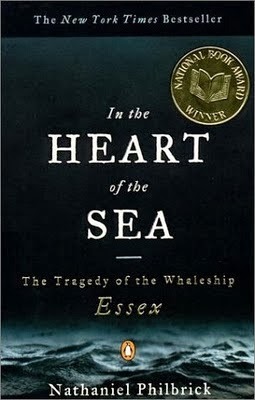
Book Review: 'In the Heart of the Sea: The Tragedy of the Whaleship Essex' by Nathaniel Philbrick

Any reader who has read 'The Life of Pi' and 'Moby Dick' should be all over this as both works of fiction were inspired by the tragic events of the Essex.  The Essex was an American whaling ship that was attacked by a disgruntled sperm whale (well the whalers had attacked it with harpoons) and sunk in the south-western Pacific in 1820. All the crew survive the sinking but they are stranded in the middle of the Pacific, in a region desolate of life, and they seem to want to make it back to civilisation the hardest way possible. Hilarity ensues. That was sarcasm.

Nathaniel does a magnificent job in describing the events on the Essex. But what also sets this book apart is his description and history of the whaling industry of Nantucket. The town is dominated by Quakers at the time and it is interesting how that justified this religion with systematic slaughter of animals and bolstered a whole industry around it. For a supposedly peaceful and placid religion, these people were blubberthirsty.I don't know if this is spoilerific (can history have spoilers?) but it also goes on to talk about the aftereffects of the tragedy and how the survivors went on living.

But the heart of the story is that of the survival of the sailors. How they relied on each other and how they tried to survive despite all odds. Having read this after years after reading 'The Life of Pi' I feel a bit ripped off. There are so many parallels in the fictional story, and it would have been great to get all the references.

A great read that taught me a lot about the whaling industry with a lot about ocean survival. Recommended to all fans of those two fictions I mentioned earlier and would make a great gift for someone going on a cruising holiday.


Monday, 16 December 2013

Returning to the Moon


So I have been absent for a few weeks from the blog. Well, at least I didn't abandon you all like we did to the moon. Thanks to China, after 37 years we have finally put another craft on the surface of the moon. The Chang'e-3 lander contained a rover called Yutu, or Jade Rabbit in Chinese. After a landing on Saturday everything seems to be go for the little rover.

The rover has a twofold mission; to explore the landing area, the dark lava plains of Bay of Rainbows in the north of Mare Ibrium, as well as deploying a telescope on the surface. The Bay of Rainbows has piqued the interests of the China National Space Agency due to its geological features. Investigation of the lava plains will lead to greater insights into the history of the moon, from when there was volcanic activity on the surface. These lava flows are presumed to have left behind lava tubes, as occurs in lava flows on Earth. Lava tubes are formed by hotter flowing lava accumulating in channels that run through cooled lava. These tunnels can be small, about 100 mm diameter, up to very large tunnels several metres in diameter. I recently visited one at Mount Kilauea, Hawaii that was large enough to take a leisurely stroll through.


These structures under the lunar surface would be perfect for future human settlement as they will easily convert to a sealed environment, with the benefit of having radiation deflecting rock above. The lack of atmosphere on the moon allows for all radiation from the sun to contact the surface; a very dangerous long-term environment for any life. The importance of finding and exploring these structures is important to future space efforts.

To aid in this underground investigation, the rover carries a ground penetrating radar system, estimated to be able to detect structural changes down to about 150m below the lunar surface. The rover also carries a scoop with a spectrometer to analyse lunar regolith samples.


Deploying a telescope on the moon is of great interest to astronomers due to the lack of atmosphere, the same reason why the Hubble telescope was so successful also. Looking through an constantly shifting atmosphere at distant stars can prove to have its difficulties.  The lander also carries an ultraviolet camera in the aim of photographing the Earth's plasmasphere, a distant part of the atmosphere where the Earth's magnetic field deflects incoming radiation from the sun. Although the plasmasphere has been mapped before, it has only been mapped from within. The new photographs will confirm the structure of the plasmasphere from the outside.

The new rover is part of the beginning of China's space program. Previously two orbiters have been successfully launched by the program, and there are plans for many more including a mission to return rock and regolith samples back to Earth in 2017. With South Korea and other countries also initiating space programs in the last year, it is definitely an exciting time for humanity. The collaborative efforts of space exploration are proving to be beyond politics. It's time to be optimistic about our futures.