Friday, 20 December 2013

Book Review: 'Shaman' by Kim Stanley Robinson

Kim Stanley Robinson's new novel may seem like a change from his past works, but in a way it fits in well with his other works. Instead of spaceships we get the end of the last ice age. And although you may think that this is a huge change in what Kim usually writes, we do get a story about humans surviving and adapting through innovation and investigation, just like all of his stories. 'Galileo's Dream' may have seemed like Kim was talking about the beginnings of science, but with 'Shaman' he shows that there are no beginnings of science and that it is essentially part of being human.

Kim has stated that his inspiration for this novel come from extensive hiking near glaciers and the type of environments that Europe would have been like at the end of the last ice age. On these hikes Kim would imagine what it would have been like to be a human at this time. Other inspiration has come from the ongoing investigation of Otzi, the five and a half thousand year old body found exposed in a glacier in 1991. Clothes and other artifacts found with the body have survived wonderfully and provide a great insight into the technology and innovation of the time.

What Kim produces is a heart-warming, coming of age tale of an apprentice shaman. We join him in his first wandering, cast aside into the wilderness naked and with no tools. We learn an awful lot about his clan and how they function in day to day life. And every character you encounter is well-drawn and is a complete individual. These people and the book itself does well to remove itself from using the standard caveman stereotype and indeed shows that 'humanity' has been with us all along and did not come about with the rise of civilisation.

I found that I did not enjoy this novel as much as some of Kim's other works such as the Mars trilogy and 'Galileo's Dream', but compared to most other works out there, it is still a brilliant and thoughtful work full of wonder and heart. In my opinion even when Kim is experimenting and trying something different like this, he could write the pants off all but a few authors.


Tuesday, 17 December 2013

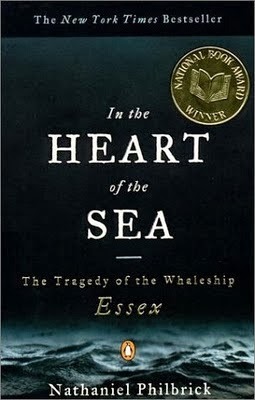
Book Review: 'In the Heart of the Sea: The Tragedy of the Whaleship Essex' by Nathaniel Philbrick

Any reader who has read 'The Life of Pi' and 'Moby Dick' should be all over this as both works of fiction were inspired by the tragic events of the Essex.  The Essex was an American whaling ship that was attacked by a disgruntled sperm whale (well the whalers had attacked it with harpoons) and sunk in the south-western Pacific in 1820. All the crew survive the sinking but they are stranded in the middle of the Pacific, in a region desolate of life, and they seem to want to make it back to civilisation the hardest way possible. Hilarity ensues. That was sarcasm.

Nathaniel does a magnificent job in describing the events on the Essex. But what also sets this book apart is his description and history of the whaling industry of Nantucket. The town is dominated by Quakers at the time and it is interesting how that justified this religion with systematic slaughter of animals and bolstered a whole industry around it. For a supposedly peaceful and placid religion, these people were blubberthirsty.I don't know if this is spoilerific (can history have spoilers?) but it also goes on to talk about the aftereffects of the tragedy and how the survivors went on living.

But the heart of the story is that of the survival of the sailors. How they relied on each other and how they tried to survive despite all odds. Having read this after years after reading 'The Life of Pi' I feel a bit ripped off. There are so many parallels in the fictional story, and it would have been great to get all the references.

A great read that taught me a lot about the whaling industry with a lot about ocean survival. Recommended to all fans of those two fictions I mentioned earlier and would make a great gift for someone going on a cruising holiday.


Monday, 16 December 2013

Returning to the Moon


So I have been absent for a few weeks from the blog. Well, at least I didn't abandon you all like we did to the moon. Thanks to China, after 37 years we have finally put another craft on the surface of the moon. The Chang'e-3 lander contained a rover called Yutu, or Jade Rabbit in Chinese. After a landing on Saturday everything seems to be go for the little rover.

The rover has a twofold mission; to explore the landing area, the dark lava plains of Bay of Rainbows in the north of Mare Ibrium, as well as deploying a telescope on the surface. The Bay of Rainbows has piqued the interests of the China National Space Agency due to its geological features. Investigation of the lava plains will lead to greater insights into the history of the moon, from when there was volcanic activity on the surface. These lava flows are presumed to have left behind lava tubes, as occurs in lava flows on Earth. Lava tubes are formed by hotter flowing lava accumulating in channels that run through cooled lava. These tunnels can be small, about 100 mm diameter, up to very large tunnels several metres in diameter. I recently visited one at Mount Kilauea, Hawaii that was large enough to take a leisurely stroll through.


These structures under the lunar surface would be perfect for future human settlement as they will easily convert to a sealed environment, with the benefit of having radiation deflecting rock above. The lack of atmosphere on the moon allows for all radiation from the sun to contact the surface; a very dangerous long-term environment for any life. The importance of finding and exploring these structures is important to future space efforts.

To aid in this underground investigation, the rover carries a ground penetrating radar system, estimated to be able to detect structural changes down to about 150m below the lunar surface. The rover also carries a scoop with a spectrometer to analyse lunar regolith samples.


Deploying a telescope on the moon is of great interest to astronomers due to the lack of atmosphere, the same reason why the Hubble telescope was so successful also. Looking through an constantly shifting atmosphere at distant stars can prove to have its difficulties.  The lander also carries an ultraviolet camera in the aim of photographing the Earth's plasmasphere, a distant part of the atmosphere where the Earth's magnetic field deflects incoming radiation from the sun. Although the plasmasphere has been mapped before, it has only been mapped from within. The new photographs will confirm the structure of the plasmasphere from the outside.

The new rover is part of the beginning of China's space program. Previously two orbiters have been successfully launched by the program, and there are plans for many more including a mission to return rock and regolith samples back to Earth in 2017. With South Korea and other countries also initiating space programs in the last year, it is definitely an exciting time for humanity. The collaborative efforts of space exploration are proving to be beyond politics. It's time to be optimistic about our futures.

Monday, 25 November 2013

Book Review: "Heads in Beds: A Reckless Memoir of Hotels, Hustles, and So-Called Hospitality" by Jacob Tomsky

This read was a bit of a gamble. Written by a employee in the hotel business it professes to tell great stories, tips on getting the best service and an insider look behind the scenes. With many other writers this could have been quite dull, but Jacob's wit, heart and cynicism makes this a great read that does deliver on all the promises.

The memoir part takes up most of the book with a chronological tale of his employment from a valet parer in a luxury hotel in the southern U.S., through the lofty heights of management, and finally to a bitter front desk clerk in New York. You get to experience the differing hotel environments in each hotel he works in and see the direct effect of these styles on the staff, which of course reflects in the service of the clients.

Jacob has wonderful tales from his time in each hotel from the classy woman who only hires a New York room for 3 hours regularly, to the CEO client who stays multiple times a week and leaves a bag behind containing some interesting luggage.
So many funny and weird tales.

Interspersed throughout is Jacob's advice to us, the paying public. How do you get the best service and the added perks? What the fuck is up with minibars and how do you get stuff for free from them? And why do people constantly underestimate the power of the front desk clerk? This person has complete control over your stay and if you treat them like shit, they can make your stay hell. The methods for making a client's stay not so nice are rather funny and clever, but do not worry, you probably won't get to experience these methods unless you are an asshole to the clerk, or do something nasty in their presence such as treating your wife, girlfriend or especially kids like crap in front of the clerk.

This book is a wonderful and fun read, with the added advantage of being educational on what happens behind the scenes in the hotel industry and how you can make the most out of your next stay at a hotel.


Sunday, 17 November 2013

Book Review: "Feynman" by Jim Ottaviani and Leland Myrick

I have been slow to discover the delights of Feynman, but I recognise a similar thinker, albeit a much, much brighter man. I love his famous BBC interview that was towards the end of his life and I did greatly enjoy his autobiographical sections in "Six Easy Pieces".

A graphic novel adaptation of Feynam's life works very well. While it does not present any new material, it takes the best snippets from all different sources and makes his life come alive with wonderful and simple illustration. Another great advantage to this medium is that the authors presented sections of Feynman lecturing and explaining physics problems. This works wonderfully and could only be bettered by watching a video of these lectures. (You can find some of his filmed lectures on Youtube).

So this was a wonderful read for a rainy Sunday afternoon. It really did capture his voice and his philosophies if I could use that term.


Saturday, 16 November 2013

Library Copy of 'Fifty Shades of Grey" Tests Positive For Herpes


For a laugh two Belgian toxicologists borrowed 10 books from their local public library and put them through toxicological and bacteriological screenings. What they found was quite intriguing.

All books were rife with bacteria. Well that should be a no-brainer, but did they run some background readings on other books, say from their own library?

Another finding was that all showed trace amounts of cocaine. Not enough for a reader to display physiological symptoms, but possibly enough to alert a drug screening.

Also, "Fifty Shades of Grey" tested positive for the Herpes virus. Very low amounts mind you and the experts say not enough to transmit the virus. But what if you have a suppressed immune system?

Anyway, support your local libraries, they do great work. Keep your cocaine away from the books though. And anyone borrowing "Fifty Shades" from the library, well you deserve what you get.

Source: http://www.deredactie.be/cm/vrtnieuws.english/News/131112_50Shades