Showing posts with label space. Show all posts
Saturday, 11 July 2015
I Love Laika
Let's hear it for Laika, the first animal in space, chosen from a pack of candidates because she was compliant and photogenic. A few days before launch one of the engineers took her home to play with his kids because he knew it would be her one last chance for joy.
On the tarmac her launch was delayed for 3 days after being sealed in the capsule. She had enough food and the scientists pumped warm air in there through a hose to stop her freezing overnight.
Her heart rate was monitored and jumped four-fold during launch. She died from heat exhaustion about 5 hours after launch.
Saturday, 11 October 2014
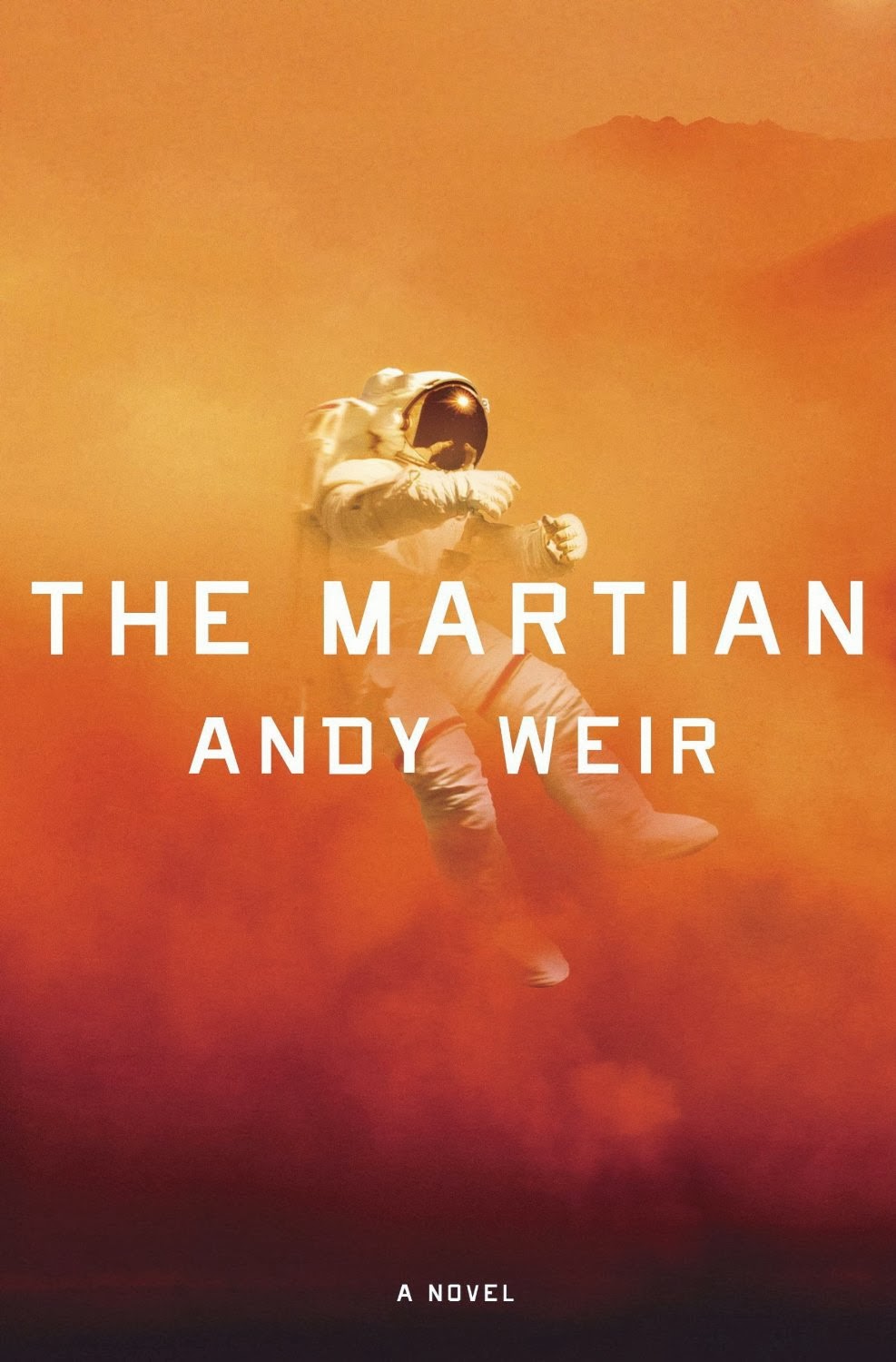
Book Review: 'The Martian' by Andy Weir
So I'm completely too late for the 'The Martian' bandwagon. It seems everyone has already read it with a smattering of really likes to the 'meh' verdicts. What decided it for me was that one 'meh' from one of my friends on Goodreads said "Too much chemistry".
What?!
Being the huge chemistry nerd that I am it was a calling sign that I was probably going to enjoy it.
And boy was it fun.
The Martian tells the story of Mark Watney, abandoned for dead by his martian crew mates after an emergency when all his life signs showed he was dead. While they rushed back to Earth, Mark wakes up in his very damaged suit to find himself alone on Mars with no hope of survival and no way to communicate with Earth.
And so The Martian is a suspenseful tale of survival. Watney is a trained botanist and mechanical engineer and he certainly uses his skills to the most. While the character is sarcastic, snarky and a bit immature, on the other hand he is humorous and entertaining. I often thought "Is this what a NASA astronaut would say? Is this how they would act?" And the answer is probably no. NASA astronauts tend to be calm yet charming people. If this is true through selection processes or as a result of running through simulations of terror for years and years we can only guess. But Mark Watney is far removed from Chris Hadfield. And while I may have found the story of an astronaut like Chris Hadfield fascinating, it may not have been a commercial SF success. Mark Watney is the perfect fusion of entertaining protagonist with smart and resourceful astronaut.
And while the story is full of suspense, it is by no means unpredictable. A quote on the cover does liken it to the recent film 'Gravity' which is a fair call. 'Gravity' was a fun, suspenseful and predictable romp just like this novel. But I'd argue that this book is much more scientifically accurate and has much more heart.

So despite these concerns, 'The Martian' kept me turning those pages in complete fascination. I was perched on the edge of my chair. I was cheering at Mark's victories, and concerned at with the disasters. And the science was wonderful. Top marks to Andy Weir especially if he isn't a qualified engineer or scientist. It passed my chemistry scrutiny with flying colours.
So I'd recommend this SF to lovers of science and SF. Some may say there is too much science, but others like me will bask in it.
Labels:
astronaut,
book review,
Mars,
NASA,
science fiction,
space
Wednesday, 26 February 2014
Massive Solar Flare
Photo from NASA / Solar Dynamics Observatory
These are a series of images taken of a massive solar flare that occurred on Monday the 24th of February. The images are of the same flare at the same moment but differ in that they are taken at different wavelengths. Kind of like if you took a photo of a butterfly at different wavelengths and one photo displayed all the red on the butterfly, another green, and so on. But these images are of light at smaller wavelengths than we can see, and at a much higher energy.
The wavelengths are given on the images in Angstroms or 10^-10 m, 100 million millionths of a metre. The light we normally see ranges from 3900-7000 Angstroms and these pictures are taken at wavelengths shorter than this. 1600 Angstroms is in the near UV spectrum, while 94 Angstroms is in the extreme UV. The actual colours shown in this photo are false and are just used to help visualise the images better.
While this is the largest recorded flare for this year, the scientists at the Solar Dynamics Observatory state that the effects were minimal here on Earth due to the location of the flare on the surface of the sun being directed away from us. No pretty aurora from this ejection.
Source: The Solar Dynamics Observatory Website.
These are a series of images taken of a massive solar flare that occurred on Monday the 24th of February. The images are of the same flare at the same moment but differ in that they are taken at different wavelengths. Kind of like if you took a photo of a butterfly at different wavelengths and one photo displayed all the red on the butterfly, another green, and so on. But these images are of light at smaller wavelengths than we can see, and at a much higher energy.
The wavelengths are given on the images in Angstroms or 10^-10 m, 100 million millionths of a metre. The light we normally see ranges from 3900-7000 Angstroms and these pictures are taken at wavelengths shorter than this. 1600 Angstroms is in the near UV spectrum, while 94 Angstroms is in the extreme UV. The actual colours shown in this photo are false and are just used to help visualise the images better.
While this is the largest recorded flare for this year, the scientists at the Solar Dynamics Observatory state that the effects were minimal here on Earth due to the location of the flare on the surface of the sun being directed away from us. No pretty aurora from this ejection.
Source: The Solar Dynamics Observatory Website.
Friday, 21 February 2014
Ronald E. McNair: Physicist and Astronaut
George Takei just shared this wonderful video on Facebook. It tells a story told by Ronald E. McNair's brother about an incident that happened in their childhood. Ronald E, McNair later became a physicist and astronaut. He was selected for the astronaut program in 1978 and later flew on the Challenger mission STS-41-B in February 1984. He was later selected for the ill-fated Challenger mission STS-51-L of January 1986 in which all crew died 73 seconds after liftoff.
The video is made by a group called 'Storycorps'.
Sunday, 16 February 2014
Book Review: 'An Astronaut's Guide to Life on Earth' by Colonel Chris Hadfield
Most of us nerds got a good idea of who Chris Hadfield is from his youtube videos last year filmed on the International Space Station. For the last few years the Mars rovers have been the sexy at NASA with the demise of the shuttle, the hitchhiking on Russian craft, oh and that psycho cross-country drive diaper caper really doing a number on NASA astronaut public image. But then Chris Hadfield and mustache came along and fixed it all up again. After a gap of 20 or so years I find myself wanting to be an astronaut when I grow up again.
So I approached this book with some delight, expecting some fun stories from his time in space; how they go to the toilet etc. Which is what you get, to some degree, but you get so much more. The same man who has enough passion to make those videos and promote space exploration so well in that medium can also write a hugely inspiring, humble and insightful work on his life, his philosophies and the universe.
Dotted between the stories of Chris' years working at NASA are wonderful insights into behavior such as how to take criticism, how to learn not to worry and plan instead, how to constructively think negatively, how to keep yourself inspired and set and achieve goals. And most importantly how not to be an asshole while doing it. These lessons meant more to me than other 'life lessons' that you see in the bookstores under self-help or inspiration. This advise made more practical sense than any quote I have seen attributed to the Dalai Lama or some such. But I don't think this type of inspiration is for everyone. I think it will be most applicable to the engineering/scientist type mindset, just like Chris himself.
So this book comes most highly recommended. I felt at times that I was right alongside Chris in parts of his journey and I listened intently to his wisdom on how to be a person with integrity, humility, determination and a sense of humour.
So I approached this book with some delight, expecting some fun stories from his time in space; how they go to the toilet etc. Which is what you get, to some degree, but you get so much more. The same man who has enough passion to make those videos and promote space exploration so well in that medium can also write a hugely inspiring, humble and insightful work on his life, his philosophies and the universe.
Dotted between the stories of Chris' years working at NASA are wonderful insights into behavior such as how to take criticism, how to learn not to worry and plan instead, how to constructively think negatively, how to keep yourself inspired and set and achieve goals. And most importantly how not to be an asshole while doing it. These lessons meant more to me than other 'life lessons' that you see in the bookstores under self-help or inspiration. This advise made more practical sense than any quote I have seen attributed to the Dalai Lama or some such. But I don't think this type of inspiration is for everyone. I think it will be most applicable to the engineering/scientist type mindset, just like Chris himself.
So this book comes most highly recommended. I felt at times that I was right alongside Chris in parts of his journey and I listened intently to his wisdom on how to be a person with integrity, humility, determination and a sense of humour.
Monday, 16 December 2013
Returning to the Moon
So I have been absent for a few weeks from the blog. Well, at least I didn't abandon you all like we did to the moon. Thanks to China, after 37 years we have finally put another craft on the surface of the moon. The Chang'e-3 lander contained a rover called Yutu, or Jade Rabbit in Chinese. After a landing on Saturday everything seems to be go for the little rover.
The rover has a twofold mission; to explore the landing area, the dark lava plains of Bay of Rainbows in the north of Mare Ibrium, as well as deploying a telescope on the surface. The Bay of Rainbows has piqued the interests of the China National Space Agency due to its geological features. Investigation of the lava plains will lead to greater insights into the history of the moon, from when there was volcanic activity on the surface. These lava flows are presumed to have left behind lava tubes, as occurs in lava flows on Earth. Lava tubes are formed by hotter flowing lava accumulating in channels that run through cooled lava. These tunnels can be small, about 100 mm diameter, up to very large tunnels several metres in diameter. I recently visited one at Mount Kilauea, Hawaii that was large enough to take a leisurely stroll through.
These structures under the lunar surface would be perfect for future human settlement as they will easily convert to a sealed environment, with the benefit of having radiation deflecting rock above. The lack of atmosphere on the moon allows for all radiation from the sun to contact the surface; a very dangerous long-term environment for any life. The importance of finding and exploring these structures is important to future space efforts.
To aid in this underground investigation, the rover carries a ground penetrating radar system, estimated to be able to detect structural changes down to about 150m below the lunar surface. The rover also carries a scoop with a spectrometer to analyse lunar regolith samples.
The new rover is part of the beginning of China's space program. Previously two orbiters have been successfully launched by the program, and there are plans for many more including a mission to return rock and regolith samples back to Earth in 2017. With South Korea and other countries also initiating space programs in the last year, it is definitely an exciting time for humanity. The collaborative efforts of space exploration are proving to be beyond politics. It's time to be optimistic about our futures.
Wednesday, 13 November 2013
Tuesday, 17 September 2013
Galaxy Cluster Abell 1689
2.25 billion light years away lies Galaxy Cluster Abell 1689, a region of the universe thick with dark matter. Each dot and swirl you see in this image is not a star, but a galaxy, 100 billion stars each.
What is so special about this far away cluster is the amount of globular clusters surrounding these galaxies. Globular clusters are old stars that orbit outside the main region of a galaxy and are thought to be leftovers from galaxy formation. The Milky Way is thought to have about 150 of these regions, but Abell is thought to have 160,000. Why is a good question and it seems to be linked to dark matter. According to NASA:
"The research team found that the globular clusters are intimately intertwined with dark matter. "In our study of Abell 1689, we show how the relationship between globular clusters and dark matter depends on the distance from the galaxy cluster's center," explained team member Karla Alamo-Martinez of the Center for Radio Astronomy and Astrophysics of the National Autonomous University of Mexico in Morelia. "In other words, if you know how many globular clusters are within a certain distance, we can give you an estimate of the amount of dark matter."
From Hubblesite and io9
Saturday, 14 September 2013
Book Review: 'A Universe From Nothing' by Lawrence M. Krauss
I guess everyone could have predicted that I would give this book 4.5 stars, if not at least agree with it's theories. Being a forthright atheist and scientist I was bound to love this book right? Well that argument could be made, but I refer you to my ratings for other atheist works such as "The God Delusion", which I must admit deserves a reread and possibly an updated higher score in retrospect, and Hitchens' "God is Not Great" which I thought was relatively poorly argued due to being essentially "look at all these bad things that religion makes people do", which anyone with any education will conclude with "no shit Hitch, but what about whether God could and may exist?".
But this book isn't really an atheist agenda, as it only answers the question of how a universe could come into existence from nothing, no energy, no trigger, no cause. This is a question I ask as a scientist an non-believer, but it also gives an answer that happens to contradict most theological thought. Coincidence? Well I guess most theories based upon the observed data over the last few centuries have done this and in effect God has been pushed further and further away until has has been left with the role of the spark. Now Lawrence is taking away that role and it pisses people off.
I guess that even though 95% of this book is purely cosmological with the only agenda is to illuminate, it is hard to not go into a science vs theology argument here as the reviews for this book on Goodreads.com, and I would surmise "The God Delusion" follow a similar pattern.
Poor reviews for this book tend to fit into the categories:
* I did not get it (it was written with too much jargon and with a steep learning curve)
* People who are offended that he had a go at philosophers.
* Religious people who tend to say "While the cosmology was interesting his conclusions were ill-found and the afterword by Richard Dawkins was just offensive."
I guess you could also argue that good reviews tend to be from scientists and atheists.
So despite being one of the best atheist arguments I have read in print, it is not going to achieve any change at all in the religious 'head-in-the-sand' type. If you are religious, don't read this book. Don't try and argue against it as you will look the fool. If you are an atheist or a scientist give it a go. It is a hard slog in sections, but it is rewarding.
I adored this book as it educated, enlightened and reconfirmed the power of science and reason.
But this book isn't really an atheist agenda, as it only answers the question of how a universe could come into existence from nothing, no energy, no trigger, no cause. This is a question I ask as a scientist an non-believer, but it also gives an answer that happens to contradict most theological thought. Coincidence? Well I guess most theories based upon the observed data over the last few centuries have done this and in effect God has been pushed further and further away until has has been left with the role of the spark. Now Lawrence is taking away that role and it pisses people off.
I guess that even though 95% of this book is purely cosmological with the only agenda is to illuminate, it is hard to not go into a science vs theology argument here as the reviews for this book on Goodreads.com, and I would surmise "The God Delusion" follow a similar pattern.
Poor reviews for this book tend to fit into the categories:
* I did not get it (it was written with too much jargon and with a steep learning curve)
* People who are offended that he had a go at philosophers.
* Religious people who tend to say "While the cosmology was interesting his conclusions were ill-found and the afterword by Richard Dawkins was just offensive."
I guess you could also argue that good reviews tend to be from scientists and atheists.
So despite being one of the best atheist arguments I have read in print, it is not going to achieve any change at all in the religious 'head-in-the-sand' type. If you are religious, don't read this book. Don't try and argue against it as you will look the fool. If you are an atheist or a scientist give it a go. It is a hard slog in sections, but it is rewarding.
I adored this book as it educated, enlightened and reconfirmed the power of science and reason.
Voyager Has Left the Solar System. No Seriously, This Time It's True.
So yet again comes the news that Voyager has left the Solar System. But this time it's a bit more reassuring as it comes from NASA itself.
But you could not be faulted for believing over the last couple of years that:
- Voyager is lost and too masculine to ask for directions.
- The edge of the solar system consists of a series of alternating stripes of Solar System and Non-Solar System.
- Spacetime is curved.to a massive degree.
- No one has any fucking idea where the Solar System starts and when it ends.
The last one is the closest. It seems that there are differing definitions upon what should constitute the edge of the solar system and these guesses end up being not so easy to be defined and measured.
I guess it's kind of like saying "Today a certain molecule of water passed from the Indian Ocean to the Atlantic Ocean". Sure these oceans have their own currents, differing salinity levels, temperatures, etc so how would you define an edge between them both? Say there was a major difference in salinities, where would you define the boundary? The average value of salinity content between the two? Sounds like a great idea but this will not give one definite line (an isosaline?) between Africa and Antarctica.
Back to space and we start defining regions by the density of ions, plasmas and the presence of magnetic fields. The main area around the Solar System is defined as the heliosphere, where the Sun's magnetic influence is strong and the area is streamed with charged ions from the sun.
Beyond the heliosphere is interstellar space, where the suns magnetic and ion influence drops almost altogether, and a high concentration of interstellar plasma takes over. The transition happens over a wide concentration gradient called the heliopause.
Looking back upon readings from August, NASA confirms a change in magnetic influence on the craft and a much greater concentration of plasma in the surroundings. I guess that NASA has made the calling that Voyager is in the latter of the heliopause if not in interstellar space. It just goes to show, definitions are hard to make.
Thursday, 5 September 2013
How Many People Are There In Space Right Now?
I often find myself wondering this.
Lucky you can just go to: http://www.howmanypeopleareinspacerightnow.com/
There are more details such as their name, mission and how long they have spent in space.
Lucky you can just go to: http://www.howmanypeopleareinspacerightnow.com/
There are more details such as their name, mission and how long they have spent in space.
Subscribe to:
Posts (Atom)