Showing posts with label book review. Show all posts

Wednesday, 4 February 2015

Book Review: "Alan Turing: The Enigma"

This book has been on my radar for years now. I found it after one of those tipping points where you finally hit the nth reference to a person or idea and you find your ignorance about it embarrassing. By the way I find that these instances only increase with the more you act upon them. Ignorance really is bliss. Anyway, along comes the film starring Sherlock himself and I found myself highly entertained by the story and wanting to know more. So it was time to tackle this volume and I come to tackle the audiobook.
22551914Firstly I want to cover the book and it's difference to the movie, because looking at the words on the print cover, "The Book That Inspired the Film 'The Imitation Game'", it leads you to a sense that a biopic from a biography should be fairly accurate. It seems that the movie took a lot of liberties and while there were not many huge outright lies, there were plenty of distortions, simplifications and exaggerations. There is a little part of me that is offended, but there is another larger part of me that is not surprised. Alan Turing was not a stereotypical genius nerd in a world that did not appreciate him. He did have a huge battle to overcome adversity due to his work being outlandish and misunderstood. It seems like Hollywood latches onto the 'Beautiful Mind' + Sheldon Cooper cookie cutter a little too much. 

I feel that I should also say that I did enjoy the movie. As far as movies go it was entertaining and also a bit educational. But I guess going into this book I expected a bit more continuity. Cumberbatch's Turing is not Hodge's biography Turing.

Hodge's biography offers a traditional chronological look at Turing's life, from a short section on his lineage to his cremation on the last page. But there is a lot more in here than what you would bargain for. Turing's work and the work leading up to is is explained in great detail. Using the term 'in depth' may be a gross under exaggeration. There is also a large section focused upon the laws concerning 'perversion' a at the time, which Turing was convicted for. If you were to remove the sections concerning math, engineering and law you'll find a book that weighs only a small percentage of the original. 

I guess what I am trying to say is that this book is not for the layman. I can only imagine that there will be a lot of copies of this book abandoned on planes, trains and bookshelves because a fan of the movie picked this book up wanting to know more, just like I did. The large sections on mathematical logic I did follow the gist of somewhat, helped along by my greater understanding of maths than the average person. Large sections of this book would only be completely understandable by people with degrees in mathematics. I chose more mathematics subjects in my science degree than the norm, so I have some sense of what is going on in these passages. I pity anyone trying to make it through without some knowledge of this type of maths. If you are a person who hates 'info-dumps' you are going to loathe this book.

But on the positive side, this was the right book at the right time for the right person. I have often found that there is no better way to learn about a person than to find the highest rated biography of that person on Goodreads that is at least 500 pages long. I have been stung with too many shorter biographies that leave me unsatisfied and finding out more information on the person's Wikipedia page. I wanted to know more about Turing and my god I found out a whole lot more.

Of course it's not all about volume. Both the writer and narrator kept me entertained for just over 30 hours. The writer was sympathetic to his subject and yet portrayed his great failings also. I really do feel that I met a person who I can call a hero (I hate that word and I am sure that there is a far greater compliment). Turing had great determination, a high regard for the truth in his work and personal life, and  a scientific approach to everything he undertook. He may be known as being a mathematician, but he was an even greater scientist who straddled fields in a time when fields were clearly defined. He often found that there was no perfect audience for his papers and that some fields would only appreciate some aspects, while other parts would not be understood at all. He was converging the sciences with mathematics.

So despite all the negatives that I noted earlier, for me not only a book to be treasured, but an introduction to a man that is greatly misunderstood and hugely under-appreciated. I want a portrait of him up on my wall alongside my Darwin portrait. I am going to get my hands on some of his writing and try to get my head around more of the maths.


Saturday, 6 December 2014

Book Review: 'The City on the Edge of Forever' by Harlan Ellison

23241668How do you create a new cut of a near 50 year old episode of Star Trek? In comic form of course.


I do not know the reason why the original author did not get the episode that he had written, nor have I seen the episode as I'm slowly working my way through Season 1 of The Original Series at the moment. So I guess that I am an unusual audience in that I am a Star Trek fan, who has been working his way backwards in the chronology and so I come across this new version of an old story before watching it myself.


And what a story! It is a brilliant read, with plenty of great Spock and Kirk moments and a very mature story for the series. It tackles some big issues without being cheesy or flippant. And the artwork is divine and very accurate. I guess the illustrator had the episode to choose stills from, but even then the likenesses in 95% of the cells are uncanny.


It's a pretty fantastic comic and a great way to while away a lazy Saturday afternoon. Maybe I'll be surprised by the differences when I finally get around to watching the episode.


Tuesday, 18 November 2014

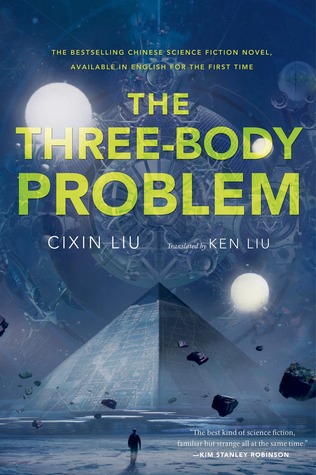
Book Review: "The Three-Body Problem" by Liu Cixin

20518872Originally published in it's native Chinese in 2008, The Three-Body Problem has now been translated for English speakers to read and enjoy. It is the first volume in a hugely successful SF trilogy that has proved to be a popular seller in China.

No matter what our opinions are on the government of China, we all know that they have a history of controlling the media. It was not so long ago that I was reading articles on how even SF stories may not be published if they contain certain themes or SF tropes that the  government does not approve of such as time travel. Yet here we have a novel that Tor are willing to bring to an international English audience. So is it a matter of government restrictions being exaggerated or is it proof that art defies restrictions?

While I can think about these questions I do hit a brick wall after a short while. I'm no geography or political buff. I have no ideas on these matters. But I do know quite a bit about SF and I know a little more about science and I feel that these are the most import factors when reading The Three-Body Problem. Sure it would have been great to know what the hell was going on in those early chapters during the 'cultural revolution', but I guess I was lucky to follow the story when it delved a bit into quantum mechanics and orbital mechanics. And while a reader without this knowledge would not have a problem following the story at all and could easily skim those sections, they definitely were rewarding and offered a greater depth to the story. And I'm sure that someone with a knowledge of modern Chinese history would have felt the same.

Three-Body is essentially the story of two scientists, Ye Wenjie, an engineer working in a top-secret military base during the 1970's, and Wang Miao, a nanotechnologist in current day China. While events in current day China unfold for Wang, the story of Ye is told in alternate sections. The nature of the top-secret base is uncovered during the intricate story and don't worry, it's not a bad X-Files ripoff at all.

But I did find Wang's story much more interesting and frightening. It explores the idea of the failure of science. What happens if over time scientific endeavors consistently defy any conjectures or postulates, refuse to comply with any previously known laws and just keep on giving random and seemingly supernatural outcomes? It may sound a bit trivial here, but the more you think about it, the more frightening it is. And the author explores this and truly did convey the horror to me as the reader. The events of this book had me tense and on-edge at several points.

There really are some fascinating ideas pursued in this book and it is a thoroughly entertaining and thought provoking read in the style of SF greats such as Kim Stanley Robinson and Asomiv. The style of interchanging stories with historical aspects, as well as some of the style did remind me of Murakami, but I have no idea if this is being literature racist as this is the only other Asian book I have read other than those by Murakami. It also had echoes of Neal Stephenson in that it was an intricate and baroque plot full of subterfuges and technical writing. But maybe I'm just projecting two of my favourite authors onto another book that I enjoyed.

So here is one reader that is converted to the forthcoming volumes and possibly converted to reading more international SF. Both Stanislaw Lem and the Strugatsky brothers failed to take my interest, but Liu Cixin has managed to produce something that I really did enjoy and also made me think big thoughts.


Thanks to NetGalley and Tor Publishing for an ebook in the exchange for an honest review.


Friday, 7 November 2014

Book Review: 'Doctor Who: Lights Out' by Holly Black

The 50th Anniversary of Doctor Who was widely celebrated last year and the Beeb teamed up with Penguin to release 11 short stories celebrating 11 Doctors. A year later and a Doctor later they have teamed up again to provide a new short story featuring the Twelfth Doctor.

22845900The authors of these stories were a selection of high profile childrens authors and the latest is written by Holly Black who has written The Spiderwick Chronicles which I hear is quite well-loved. To tell the truth I did have a mixed response to the previous stories ranging from the utter brilliance of Neil Gaiman's 'Nothing O'Clock' to the utter embarrassment that was  'A Big Hand For the Doctor'. While I do appreciate the Beeb trying something new with written Who, there are already plenty of tried and true Who writers out the who could have done a much better job of the whole enterprise. 

So for completist sake, natural curiosity, hope and love for my Doctor I approached this new volume with some trepidation. How good could a writer capture the new Doctor when we have only just seen him unfold on-screen? And how would they go writing for one of the most complicated Doctors that we have met? There certainly no longer remains the facade of an upstanding moral fighter. There is a lot more ambiguity in the Doctors motivations these days.

Surprisingly 'Lights Out' is firmly set within the series with the Doctor travelling to a famous coffee-specialising planet in search for a couple of cups for himself and Clara after the events in Deep Breath. The Doctor soon finds himself a suspect in a hideous murder and meets a being called '78351' who was also witness to the murder. 78351 becomes his companion for the duration of the story.

While the plot itself is by no means new or original, Holly does manage to bring in some aspects of the Twelfth Doctor and more than just the physical eyebrows joke. The Doctor does seem morally ambiguous and does let events take a different course to what another Doctor may have done. He does seem nonplussed at the deaths themselves. There certainly is the Twelfth Doctor within these pages.

So while this is a light and unsurprising read, the surprise is in how the Twelfth Doctor comes across on paper - much like he does onscreen thankfully. While I have not had a chance to read the three full-sized novels  recently released featuring the Twelfth Doctor, I can say to anyone looking for some Twelve in print that you have come to the right place.


Monday, 27 October 2014

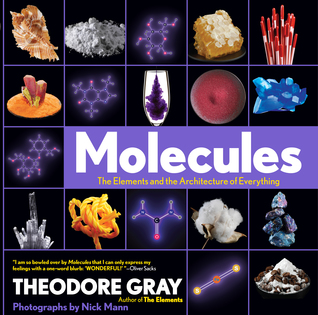
Book Review: 'Molecules: The Elements and the Architecture of Everything' by Theodore Gray

20729580Moving on from his wonderful books on DIY chemistry experiments (Theo Gray's Mad Science: Experiments You Can Do At Home - But Probably Shouldn't) and his glossy, beautiful and somewhat erotic (well us chemists get our kicks where we can) The Elements: A Visual Exploration of Every Known Atom in the Universe, Theo takes us a step up in complexity and deals with the realm of molecules in his latest glossy coffee table book to end all coffee table books.

Sure there is less structural narrative here than in 'The Elements' because we lack the periodic table, but the themes selected by Theo are great and do tie together somewhat. What you find are sections on soaps, sweeteners, dyes, aromatic compounds and a variety of others. Each section is contains the beautiful photography of Nick Mann as well as lots of structures and weird facts. 

Another aspect that I love about Theo's books are that I am not bored reading them and despite my wide reading and years of education and educating in chemistry there are still a variety of weird facts that I come across in his books. Admittedly I was a little bored in the first couple of chapters of 'Molecules' because it did lay down the foundations of what molecules are and how the atoms bond. But it is always great to read how another greatly intelligent person explains these basics to a non-educated audience. It is part of my job to do this for fresh faced university undergraduates. 


Yes I am possibly a bit biased being both a chemist and a big fan of Theodore's previous books but 'Molecules' kept me fascinated for hours and it is a book that I will revisit quite often. It may not be quite as catchy and as structured as 'The Elements', but close to perfection is still a commendable achievement.


Tuesday, 21 October 2014

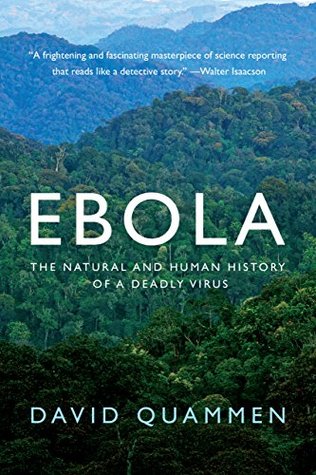
Book Review: 'Ebola: The Natural and Human History of a Deadly Virus' by David Quammen

For the last few months now our news cycles have always had a little snippet of Ebola news hidden somewhere between the wedding of George Clooney and a dog that got stuck up a tree. The only visuals are dusty hut, a dirty warehouse that is supposed to be a hospital and some people with paper face masks. And while it seems like a big story, you know that it is being downplayed because it is in Africa, still the dark continent in the 21st century. Yet the story has been there for months. Enough for some alarm bells to ring, hey this might be serious. But oh wait, Miley Cyrus just did something.
23305848
Usually by this time I'd be Googling Ebola, or buying a New Scientist with a special set of articles on the subject, but I haven't. But luckily I had a quick browse on NetGalley and came across this book. So I approached this volume hoping that all my curiosities would be quelled; what is Ebola exactly?  How is it transmitted? What effects does it have on the body? Where does it hide in it's downtime?

Were my questions answered? Not exactly. But through no fault of the author's at all.

I had no idea how little we know about Ebola. 

David starts his new book acknowledging that it is a rehash of a section from his previous book from 2012 'Spillover' that looks at zoonoses or an infection that is transmissible from animal to human. The majority of this book is not new material and is taken heavily from the aforementioned volume, but it has some small sections updated until early September 2014 regarding the new outbreaks. And while cynics will see this as a cash in on a new range of deaths I saw this as being far from it as it was an informative piece of writing that answered all the questions that it could regarding Ebola and introduced me to a writer who I had never read before and will probably go on to read in the near future.

The small book takes us through a short history of Ebola outbreaks ever since the first recorded outbreaks in the 1970s. It is also interspersed with a first hand account from David when he traveled through one region that had previously had outbreaks with a biological survey. So not only was the overview of the history of outbreaks fascinating, but it had personal stories from the people affected inbetween.


But the most astonishing aspect of the disease is how little is known about it for various reasons. When you have a virus that stays dormant for years in a non-human host, and then sudden outbreaks happen in the most remote places of Africa, where there are minimal survivors, and those that are infected die very quickly you have a very hard virus to study. Not only that but it is one of the most deadly viruses known and studies done with samples in laboratories require large amounts of risk minimisation and therefore large amounts of funding. So while a known set of symptoms are present the exact mechanism of how the virus interacts with the body still requires a great deal of work. It is known to devastate the patients immune system and also cause uneven clotting in the cardiovascular system so that clots appear in some areas while other bleed uncontrollably from the slightest rupture say of a needle.

David presents a short volume that is engrossing, horrific and truthful. I have come away with a much greater understanding of the complexities of the situation in these west-African countries and how their political and belief systems are exacerbating the situation. However I also know that the rest of the world could be putting in a greater effort and not dismissing it as yet another plight of the African or having undue panic and believing that it is a sign of the oncoming apocalypse. 

Thank you to Netgalley and Random House UK for a copy of this book to review.


Sunday, 19 October 2014

Book Review: 'The Chrysalids' by John Wyndham

11228582It is certainly easy to classify John Wyndham's The Chrysalidsas old school YA fiction, from before YA fiction needed a label, but it offers more than your average after school special between covers in that it treats the reader as an intelligent and reasonable person, and that while there is a touch of the 50s to the book, it was certainly way ahead of its time.

David Strorm is the only living son of a patriarch of an ultra-religious post-apocalyptic community. Faced a level of mutation in the their farming stock, both plants and animals, the community has twisted the christian faith into a fundamentalist view that any variation is a sin against god and must be burnt. This is handled by the community and by appointed inspectors. A few plants that don't quite grow to perfection and a whole crop is burnt to the ground. While this may have helped a little curb the proliferation of any mutagens that may be harmful to humans, it has certainly held back any natural selection processes. 

Unfortunately the rules do not end at the farm. Any human born not in god's image is not certified by the inspectors and is taken, hushed up and forgotten. There is also an unspoken rule that a female who produces offspring three times that do not get certified is taken away and quite possibly treated like the livestock that also do not produce. It is a frightening and terror filled community, one that brings back memories of Atwood's A Handmaid's Tale

So everyone in this community has a stamp of approval that they fit the image of god in all their looks. But what happens if there is a variation that an inspector cannot see? David learns from an early age that he can communicate with a small group of others telepathically. This small group of children band together in their fear and strategise to hide their differences in fear for their lives. But all is changed when people notice their strange behaviour when one of their kind is hurt and they come to their rescue with no seemingly way of knowing that the person was injured.


At a guess I have probably read The Chrysalids about a dozen times. Mostly in my teens as I worked my way through whatever John Wyndhams I could find in my local and school libraries after discovering The Day of the Triffids. So any John Wyndham is a comfort read for me. A mix of good sturdy SF with nostalgia. Truthfully this book probably deserves a 4 star rating, but it means a lot to me. It was the Wyndham that made me that much more confident as a teen who did not fit in. It introduced me to religious fundamentalism. And it also made it OK to be a daydreamer. I think all the John Wyndhams that I read as a teen have made me a better person in the long run. I certainly wouldn't be the same person had I not read and loved them.

Saturday, 11 October 2014

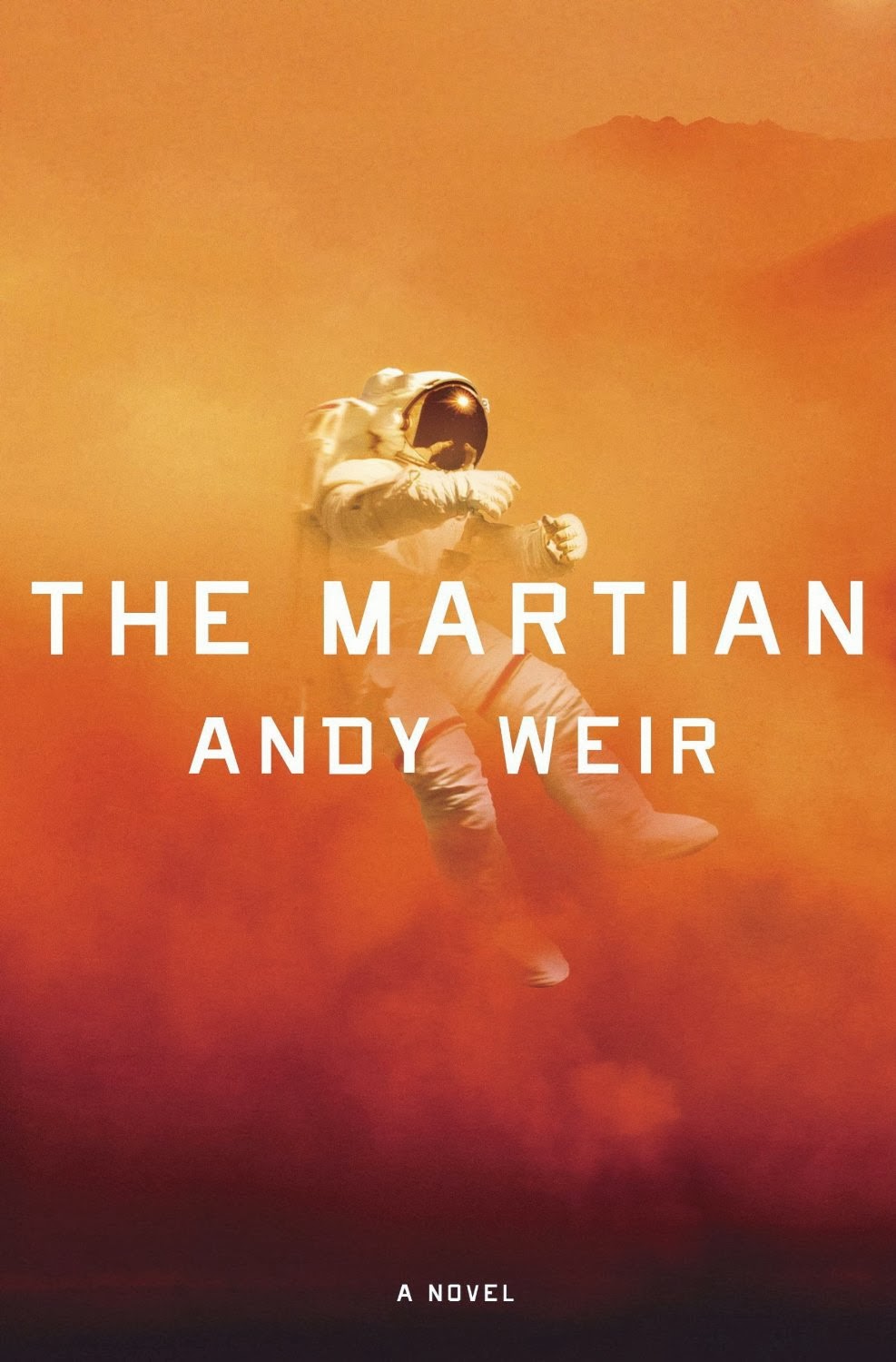
Book Review: 'The Martian' by Andy Weir

So I'm completely too late for the 'The Martian' bandwagon. It seems everyone has already read it with a smattering of really likes to the 'meh' verdicts. 

What decided it for me was that one 'meh' from one of my friends on Goodreads said "Too much chemistry".

What?!

Being the huge chemistry nerd that I am it was a calling sign that I was probably going to enjoy it.

And boy was it fun.

The Martian tells the story of Mark Watney, abandoned for dead by his martian crew mates after an emergency when all his life signs showed he was dead. While they rushed back to Earth, Mark wakes up in his very damaged suit to find himself alone on Mars with no hope of survival and no way to communicate with Earth. 

And so The Martian is a suspenseful tale of survival. Watney is a trained botanist and mechanical engineer and he certainly uses his skills to the most. While the character is sarcastic, snarky and a bit immature, on the other hand he is humorous and entertaining. I often thought "Is this what a NASA astronaut would say? Is this how they would act?" And the answer is probably no. NASA astronauts tend to be calm yet charming people. If this is true through selection processes or as a result of running through simulations of terror for years and years we can only guess. But Mark Watney is far removed from Chris Hadfield. And while I may have found the story of an astronaut like Chris Hadfield fascinating, it may not have been a commercial SF success. Mark Watney is the perfect fusion of entertaining protagonist with smart and resourceful astronaut. 

And while the story is full of suspense, it is by no means unpredictable. A quote on the cover does liken it to the recent film 'Gravity' which is a fair call. 'Gravity' was a fun, suspenseful and predictable romp just like this novel. But I'd argue that this book is much more scientifically accurate and has much more heart. 


So despite these concerns, 'The Martian' kept me turning those pages in complete fascination. I was perched on the edge of my chair. I was cheering at Mark's victories, and concerned at with the disasters. And the science was wonderful. Top marks to Andy Weir especially if he isn't a qualified engineer or scientist. It passed my chemistry scrutiny with flying colours.

So I'd recommend this SF to lovers of science and SF. Some may say there is too much science, but others like me will bask in it.


Friday, 7 March 2014

Book Review: 'You Are Not So Smart' by David McRaney

This great work boils down to: "Despite millions of years of evolution your brain is a jumbled mess of neurons that covers up it's downfalls by lying to you constantly. Here are just 46 ways your brain is being an asshole."

Just like Dawkins argues against a creator in showing that evolutionary adaptations can be flawed and seemingly badly designed, David McRaney shows in this work that despite those claims that the human mind is one of the most complex structures in the known universe, it's shoddily put together, with bits that don't work together and bits that were added on at the last minute and that the only way it 'works' is that it constantly lies to itself about the reality it exists in. You have in your head a used car salesman.

David demonstrates the limitations of our brains by picking out these 46 different ways our brain lies to us and writing a small chapter on each. Each lie is well researched and refers to different published studies for evidence. For example the chapter on why you have too many Facebook friends talks about studies about the limitations of how many people you can hold in a social circle in the physical world and compares these figures to the data on Facebook. He also talks about the reason why you 'befriend' all those people using the internet.

Most interesting are the chapters that highlight the limitations in vision and the comprehension of sensory input. You are not a little person in a box watching a ultra high definition surround sound movie of your existence. More like your homonculus watches a scratchy silent movie from 1908 with no sound and missing film cells, a friend tells them about the soundtrack over the phone.

There are also great chapters on how you think you are better than everyone else out there. He actually gives statistics on how many people think they are better than average drivers and how many people think they have a better than average IQ. The figures will astound you.

I highly recommend this fun and enlightening read. It certainly will make you question everything you think and perceive, which is a practice that all science endorses strongly. This book is so much more than your average pop-psychology book that litters the popular science section of bookshops and libraries. It holds no punches and approaches the subject from a critical standpoint. Weeks after reading this book I'm still laughing at my brain when I know it's lying to me.


Sunday, 16 February 2014

Book Review: 'An Astronaut's Guide to Life on Earth' by Colonel Chris Hadfield

Most of us nerds got a good idea of who Chris Hadfield is from his youtube videos last year filmed on the International Space Station. For the last few years the Mars rovers have been the sexy at NASA with the demise of the shuttle, the hitchhiking on Russian craft, oh and that psycho cross-country drive diaper caper really doing a number on NASA astronaut public image. But then Chris Hadfield and mustache came along and fixed it all up again. After a gap of 20 or so years I find myself wanting to be an astronaut when I grow up again.

So I approached this book with some delight, expecting some fun stories from his time in space; how they go to the toilet etc. Which is what you get, to some degree, but you get so much more. The same man who has enough passion to make those videos and promote space exploration so well in that medium can also write a hugely inspiring, humble and insightful work on his life, his philosophies and the universe.

Dotted between the stories of Chris' years working at NASA are wonderful insights into behavior such as how to take criticism, how to learn not to worry and plan instead, how to constructively think negatively, how to keep yourself inspired and set and achieve goals. And most importantly how not to be an asshole while doing it. These lessons meant more to me than other 'life lessons' that you see in the bookstores under self-help or inspiration. This advise made more practical sense than any quote I have seen attributed to the Dalai Lama or some such. But I don't think this type of inspiration is for everyone. I think it will be most applicable to the engineering/scientist type mindset, just like Chris himself.

So this book comes most highly recommended. I felt at times that I was right alongside Chris in parts of his journey and I listened intently to his wisdom on how to be a person with integrity, humility, determination and a sense of humour.


Sunday, 9 February 2014

Book Review: 'The Hobbit' by J.R.R. Tolkien

So after 20 or so years, I finally got around to rereading 'The Hobbit' and it was like reading it anew. I obviously had no previous memories of it, and I'd guess that although I read read it as a precocious child who read beyond their age, I didn't really comprehend that much. Even though this is geared towards a younger audience.

But this time I had so much fun. The prompting to get my finger out was my enjoyment of the movies, especially 'The Desolation of Smaug' (going to re-watch it again in a couple of days). So it was high time I read it.

I guess with the movies being out there and the book being well-read I don't need to talk much about the story. It is a simple story, but for when it was written it was virtually unique. And you can tell that it is written to be read out loud. I'm going to have to purchase an audiobook of this.

So what more can I say? I had a lot of fun reading this and I am ashamed it took me so long to get around to it. Tolkien is the only author that I'll read that can have a dragon on the cover and a map of pointy mountains at the beginning of the book. Have you read it yet? If you haven't why haven't you? Get around to it. You'll have a lot of fun.


Saturday, 8 February 2014

Book Review: 'On The Map' by Simon Garfield

Who here loves maps and can pore over a map of an unknown territory, real or fictional, for hours imagining the geography and the adventures to be had? Yeah you are one of those people, a lot of us are. In fact I'd hazard to say that a majority of geeks and nerds are. It's part of who we are and a natural expression of our imagination and deep passion for things.

In the last couple of years there has been a few books about maps starting to be published. It seems that we are all rediscovering our childhoods love of the atlas and also discovering that we weren't the weird outsider we thought we were. The last book on maps I read was a beauty, 'Maphead' by the wonderfully hilarious Ken Jennings (see my review on goodreads.com). Ken takes a look at several applications of mapping in the last few decades and engages with these activities, interviews people involved and just has a lot of fun.

'On the Map' provides a different and more traditional look at maps by presenting a chronological history of cartography via selected maps, or mapping techniques. Simon takes us on a journey from the very first attempts at mapping the known world, the Mappa Mundi, right through to GPS systems and mapping in video games.

It's hard not to compare Simon's work with Jennings' even though they take a different perspective upon the subject and do compliment each other. There were some points where I felt a little let down by Simon, but I'll get to those points after, because despite these, it was a damn good read. Simon has chosen by far some very interesting tales to tell about the history of cartography, and it seems he has done a great deal of research. Each chapter is clear and concise and very entertaining. It is clear that Simon is a great fan of maps and is enthusiastic to share.

But onto those niggling negatives, and there are only two. Firstly, there is a chapter on mapping in video games that is quite well-researched and he admits that the maps and geography in these games are intricate and the effort that goes into these works is astounding. Yet he writes derisively about these games being time wasters and infers that people who play these games are on the fringe of society. Surely he has heard of leisure activities and that normal people play these games not just unemployed stoners. Anyway, being a bit of a gamer, especially a fan of sandbox games, where mapping and geography get expressed in the most beautiful ways, I felt disappointed  that Simon did not express a greater understanding and appreciation of these points.

Secondly, there were instances when Simon interviewed  a person about a subject that he was writing about and mentions going to meet this person etc. But sometimes there was no more information about this meeting or person for more than a paragraph. I am supposing that most of what he talked to the person about made it into the text as pure information, but it seemed like that in a few instances I would have liked to have heard more from that person and about that person. I know I have written a lot about these negatives, but they are very small.

I purchased this book without looking at a single review and it was a great surprise that it was so good. I don't often purchase books blindly these days. Part of the motivation was that a few weeks previously I had visited a great exhibition of maps in Canberra (National Library for all the Australians. Go see it!). It was a great surprise to have a major part of a chapter about one of the highlights of that exhibition, the Fra Mauro world map, an imposing approx 3m X 3m intricately detailed 15th century map.


So Simon has produced a wonderful work that expresses deep love for the subject. It is both a fun and informative read that is also well-written. I'd recommend this book for anyone who loves maps. Yes you!


Friday, 20 December 2013

Book Review: 'Shaman' by Kim Stanley Robinson

Kim Stanley Robinson's new novel may seem like a change from his past works, but in a way it fits in well with his other works. Instead of spaceships we get the end of the last ice age. And although you may think that this is a huge change in what Kim usually writes, we do get a story about humans surviving and adapting through innovation and investigation, just like all of his stories. 'Galileo's Dream' may have seemed like Kim was talking about the beginnings of science, but with 'Shaman' he shows that there are no beginnings of science and that it is essentially part of being human.

Kim has stated that his inspiration for this novel come from extensive hiking near glaciers and the type of environments that Europe would have been like at the end of the last ice age. On these hikes Kim would imagine what it would have been like to be a human at this time. Other inspiration has come from the ongoing investigation of Otzi, the five and a half thousand year old body found exposed in a glacier in 1991. Clothes and other artifacts found with the body have survived wonderfully and provide a great insight into the technology and innovation of the time.

What Kim produces is a heart-warming, coming of age tale of an apprentice shaman. We join him in his first wandering, cast aside into the wilderness naked and with no tools. We learn an awful lot about his clan and how they function in day to day life. And every character you encounter is well-drawn and is a complete individual. These people and the book itself does well to remove itself from using the standard caveman stereotype and indeed shows that 'humanity' has been with us all along and did not come about with the rise of civilisation.

I found that I did not enjoy this novel as much as some of Kim's other works such as the Mars trilogy and 'Galileo's Dream', but compared to most other works out there, it is still a brilliant and thoughtful work full of wonder and heart. In my opinion even when Kim is experimenting and trying something different like this, he could write the pants off all but a few authors.


Tuesday, 17 December 2013

Book Review: 'In the Heart of the Sea: The Tragedy of the Whaleship Essex' by Nathaniel Philbrick

Any reader who has read 'The Life of Pi' and 'Moby Dick' should be all over this as both works of fiction were inspired by the tragic events of the Essex.  The Essex was an American whaling ship that was attacked by a disgruntled sperm whale (well the whalers had attacked it with harpoons) and sunk in the south-western Pacific in 1820. All the crew survive the sinking but they are stranded in the middle of the Pacific, in a region desolate of life, and they seem to want to make it back to civilisation the hardest way possible. Hilarity ensues. That was sarcasm.

Nathaniel does a magnificent job in describing the events on the Essex. But what also sets this book apart is his description and history of the whaling industry of Nantucket. The town is dominated by Quakers at the time and it is interesting how that justified this religion with systematic slaughter of animals and bolstered a whole industry around it. For a supposedly peaceful and placid religion, these people were blubberthirsty.I don't know if this is spoilerific (can history have spoilers?) but it also goes on to talk about the aftereffects of the tragedy and how the survivors went on living.

But the heart of the story is that of the survival of the sailors. How they relied on each other and how they tried to survive despite all odds. Having read this after years after reading 'The Life of Pi' I feel a bit ripped off. There are so many parallels in the fictional story, and it would have been great to get all the references.

A great read that taught me a lot about the whaling industry with a lot about ocean survival. Recommended to all fans of those two fictions I mentioned earlier and would make a great gift for someone going on a cruising holiday.


Monday, 25 November 2013

Book Review: "Heads in Beds: A Reckless Memoir of Hotels, Hustles, and So-Called Hospitality" by Jacob Tomsky

This read was a bit of a gamble. Written by a employee in the hotel business it professes to tell great stories, tips on getting the best service and an insider look behind the scenes. With many other writers this could have been quite dull, but Jacob's wit, heart and cynicism makes this a great read that does deliver on all the promises.

The memoir part takes up most of the book with a chronological tale of his employment from a valet parer in a luxury hotel in the southern U.S., through the lofty heights of management, and finally to a bitter front desk clerk in New York. You get to experience the differing hotel environments in each hotel he works in and see the direct effect of these styles on the staff, which of course reflects in the service of the clients.

Jacob has wonderful tales from his time in each hotel from the classy woman who only hires a New York room for 3 hours regularly, to the CEO client who stays multiple times a week and leaves a bag behind containing some interesting luggage.
So many funny and weird tales.

Interspersed throughout is Jacob's advice to us, the paying public. How do you get the best service and the added perks? What the fuck is up with minibars and how do you get stuff for free from them? And why do people constantly underestimate the power of the front desk clerk? This person has complete control over your stay and if you treat them like shit, they can make your stay hell. The methods for making a client's stay not so nice are rather funny and clever, but do not worry, you probably won't get to experience these methods unless you are an asshole to the clerk, or do something nasty in their presence such as treating your wife, girlfriend or especially kids like crap in front of the clerk.

This book is a wonderful and fun read, with the added advantage of being educational on what happens behind the scenes in the hotel industry and how you can make the most out of your next stay at a hotel.


Sunday, 17 November 2013

Book Review: "Feynman" by Jim Ottaviani and Leland Myrick

I have been slow to discover the delights of Feynman, but I recognise a similar thinker, albeit a much, much brighter man. I love his famous BBC interview that was towards the end of his life and I did greatly enjoy his autobiographical sections in "Six Easy Pieces".

A graphic novel adaptation of Feynam's life works very well. While it does not present any new material, it takes the best snippets from all different sources and makes his life come alive with wonderful and simple illustration. Another great advantage to this medium is that the authors presented sections of Feynman lecturing and explaining physics problems. This works wonderfully and could only be bettered by watching a video of these lectures. (You can find some of his filmed lectures on Youtube).

So this was a wonderful read for a rainy Sunday afternoon. It really did capture his voice and his philosophies if I could use that term.


Tuesday, 12 November 2013

Book Review: "The Goldfinch" by Donna Tartt

I have been getting rather annoyed with blurbs the last few years and I am trying to steer clear of them as much as possible. Of course they come in handy for judging a book quickly and I do read them for unknown authors or authors that are hit or miss. After reading a book and looking at the blurb I have often thought "That's a bit spoilery. I could have done not knowing about that."  Why do blurbs have to contain spoilers of the first 100 pages of plot?

Anyway my point is with "The Goldfinch" is I made a concerted effort to avoid blurbs or any description of any kind before reading it. And looking back at the blurb now I have to say:

DON'T READ THE BLURB!

I would have been so disappointed with that knowledge. Sure sometimes I get pissed off with books with no blurb and just quotes from Bill Bryson and Stephen Hawking. But this is me this time, and this is my gushing thumbs up, and that means more than Bill Bryson's. And therefore this review is just going to amount to a huge gush of adoration with no plot details at all.

Of course I can tell you all what I loved about this book apart from plot details. And the plot was great. Lots of surprises, lots of intrigue. The characters are all wonderful, both to love and to hate. The writing is just so fucking brilliant. 800 or so pages in just under 3 days. That is how good.

I also loved Donna's "The Secret History" for a lot of the same reasons. She has definitely become one of my favorite authors, and it is good to know that she is popular. A rare overlap between what the masses love and what I love.

I don't know if this is an adequate review. But I loved it. And you should read it.


Friday, 8 November 2013

Book Review: "Heretics: Adventures with the Enemies of Science" by Will Storr

In my mind Will Storr is the brilliant love-child of Mary Roach and Louis Theroux, both of whom I adore. I think Will may have to join their lofty heights in my respectability/adoration mind shrine.

Will's "Will Storr vs the Supernatural" was a wonderful and random find that I made several years ago. Will took it upon himself, Louis Theroux style, to get immersed in the lore and activity of the supernatural. What was different about the other supernatural books is that Will approached it from a skeptical point of view. His conclusions were  that most of what he investigated was utter bullshit, but there were a few instances that made him think. That book was much better than Mary Roach's approach taken in her book "Spook".

Anyway, this time Will has taken on the enemies of science. Well more like the enemies of reason. SO each chapter or two is dedicated to an interview or an activity with a fringe group or person. You start with a creationist preacher, move through to holocaust deniers and take on homeopathy. All sections are well-researched and Will approaches each instance with a sympathetic ear. That ear may not last long, but he does have the best of intentions.

All throughout Will is bringing this all back to the nature of belief and the apparent need for the human brain to make reliable sense of the world it exists in. So there is a greater message other than "Look at these dickheads" and a great attempt to try and understand human thought processes.

In it's own way I think that this book adds it's own to a religion vs. science argument and should be considered essential reading for anyone tackling this subject. It definitely should be as popular and as read as Dawkins' "The God Delusion" and makes a much more logical assay of belief than Hitchens' "God is Not Great". It had a die-hard atheist like myself thinking as opposed to going "right on!" to every point.


Book Review: "Pedro and Me" by Judd Winnick

I know this looks like the cover to an after school special, and it is actually like an after school special. But don't judge me.

I first came across Judd's work with the hilarious "Barry Ween" series which I do adore (I should write reviews for them). But I did not enjoy his collection of "Frumpy the Clown", which was unfunny newspaper type strips. So I picked this up a few years ago with no idea what it was about.

Turns out it's an autobiographical comic on the author's relationship with his friend Pedro, who was an AIDS advocate in the 90's. They met by becoming roommates in a MTV reality show. There are no surprises here and it ticks all the boxes for being a heartfelt story with a message.

But what really spoke to me reading it this time through  is the message of acceptance of differences and the need to be exposed to diversity. In the final stages of the audition process for the show Judd was asked by the producers if he was comfortable to share a room with someone who is HIV positive. Being a liberal kind of guy he didn't even think before saying yes, but then later admits that he did have some prejudice based purely on ignorance of how the disease is transmitted and how would that impact on him sharing a room with Pedro. Of course everything turns out fine, but it took a little bit of time (not as much as what you may think) to get used to living with someone like this. I think it goes to show that no matter how liberal we may be in our views, until we are close to someone who is different we are probably just full of idealistic words. Here it was someone with HIV, but in our lives we need to expose ourselves to all kinds of different people.

We have gained a multitude of sources for HIV education and this may be a great source to give to people who do not read novels or for teenagers. But I think the main strength is the message of equality and exposing yourself to different people. No, not in a trench-coat-wearing way.


Thursday, 24 October 2013

Book Review: 'Death at SeaWorld: Shamu and the Dark Side of Killer Whales in Captivity' by David Kirby

'Death at Seaworld' is a fascinating and meticulously researched work that centres upon the death of a killer whale trainer at the U.S. theme park in 2010. However the work also takes on the entire history of the captivity of these whales, as well as research undertaken in the wild.
What you get to read may be argued as one-sided as it argues strictly against the captivity of killer whales, but with the evidence presented, there is no other conclusion that could be reached. It does essentially come down to animals performing under extreme duress for the pleasure of humans to bring in dollars.

There is a lot of focus on policy and politics about marine mammals in the U.S., but it never gets bogged down in too much detail, and the people who played a part in these affairs are well-drawn and interesting people in their own right.

An interesting section looks at the plight of Keiko, the star of the 'Free Willy' movie. Keiko was hired from a Mexican animal park to star in the movie. The conditions that he was in were dismal with a very small concrete tank, that was so shallow that his pectoral fins always touched the bottom and had lesions on them. The tale of his journey being an experimental re-release into the wild is a wonderful and enlightening story.

I guess what also sets this work apart from the usual anti-captivity arguments is that it is strictly about killer whales. The author does make an argument for captivity of certain species for educational and conservationist purposes. He is not a die-hard anti-this anti-that person. The argument put forward is strictly about this species and it's conditions and treatment in captivity.

So if you are a bit of a zoological nut check this book out. I highly recommend it.