Showing posts with label chemistry. Show all posts

Monday, 27 October 2014

Book Review: 'Molecules: The Elements and the Architecture of Everything' by Theodore Gray

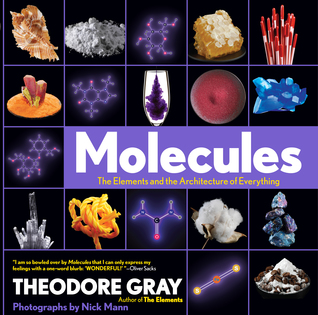
20729580Moving on from his wonderful books on DIY chemistry experiments (Theo Gray's Mad Science: Experiments You Can Do At Home - But Probably Shouldn't) and his glossy, beautiful and somewhat erotic (well us chemists get our kicks where we can) The Elements: A Visual Exploration of Every Known Atom in the Universe, Theo takes us a step up in complexity and deals with the realm of molecules in his latest glossy coffee table book to end all coffee table books.

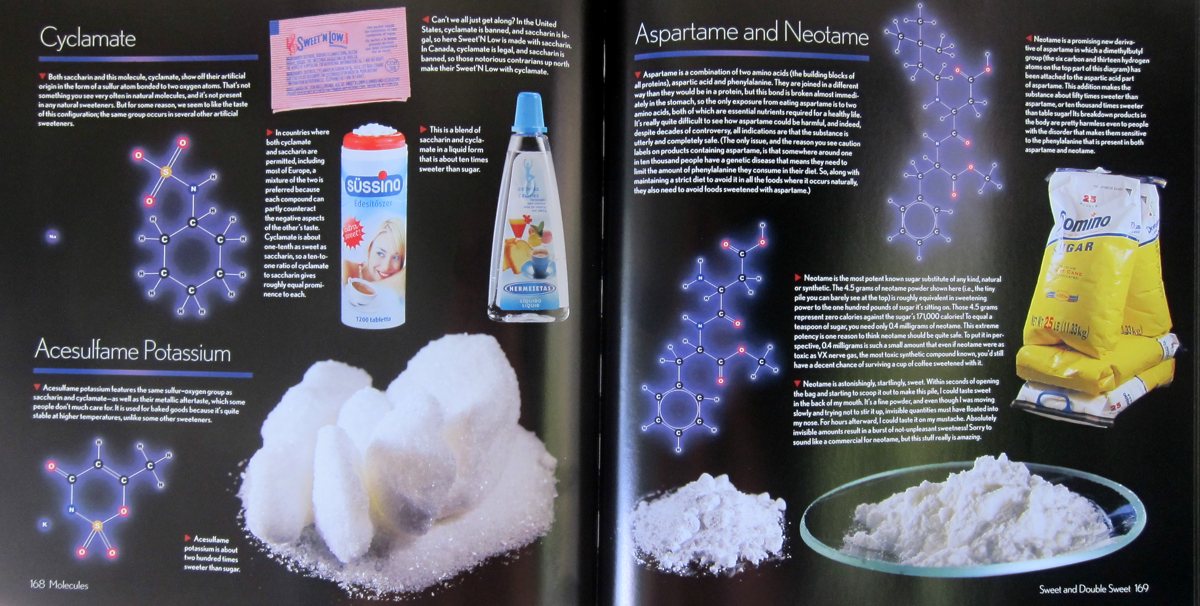
Sure there is less structural narrative here than in 'The Elements' because we lack the periodic table, but the themes selected by Theo are great and do tie together somewhat. What you find are sections on soaps, sweeteners, dyes, aromatic compounds and a variety of others. Each section is contains the beautiful photography of Nick Mann as well as lots of structures and weird facts. 

Another aspect that I love about Theo's books are that I am not bored reading them and despite my wide reading and years of education and educating in chemistry there are still a variety of weird facts that I come across in his books. Admittedly I was a little bored in the first couple of chapters of 'Molecules' because it did lay down the foundations of what molecules are and how the atoms bond. But it is always great to read how another greatly intelligent person explains these basics to a non-educated audience. It is part of my job to do this for fresh faced university undergraduates. 


Yes I am possibly a bit biased being both a chemist and a big fan of Theodore's previous books but 'Molecules' kept me fascinated for hours and it is a book that I will revisit quite often. It may not be quite as catchy and as structured as 'The Elements', but close to perfection is still a commendable achievement.


Wednesday, 23 April 2014

Someone's taking the Piss

In the early morning of the 16th of April a teenager from Portland in the U.S. drunkenly peed into one of the city's drinking water reservoirs. The trouble is that he did it in front of a security camera and this footage has gone public. The city's solution: drain and dump 145 million litres of drinkable water. 

A spokesperson from the governing body stated that it was understood that there was no risk from the urine but it was decided to dump the water due to the public's "perceived difference"or as I like to call it "ignorance".


This action is unimaginably wasteful and pandering to the lowest common denominator. Take a look at this reservoir or indeed any reservoir. Dead animals, algae, rubbish, particulates. Are we really worried about that amount of pee?

Lets do some quick calculations.

Wikipedia states that most bladders hold between 500 - 1000 mL. Lets go for the worst possible scenario and say 1L of pee went in. So essentially the the pee is diluted 145 million times. Or if you take a glass of this water, you may drink 1.7 nanolitres of this guys piss. You probably drink a larger volume of your own pee after you go to the toilet, wash your hands and eat something from your hands.


Tuesday, 15 April 2014

Theo Gray's Periodic Table of Elements Cards


For all of you not in the know Theo Gray is an element collector and author of several amazing works that I adore. He takes beautiful photos of the objects and he has published them in one of his earliest works 'The Elements'. After the success of this book he has since put out other books, a jigsaw puzzle, calenders and this deck of cards. 
Like all of his work they are a combination of great visuals, great design and a smattering of great and accurate information. 

Of course Theo didn't just design these as flip cards, but as decoration and playing around with. So this morning I found myself moving some furniture and constructing a periodic table with these cards. It left a  this science nerd very happy.


Monday, 2 September 2013

The Rise of Element 115

The limits of the Periodic Table of Elements (that other less famous table) continue to be pushed with a Swedish group from Lund University reporting the manufacture of element 115. This is the second group to do so, with a Russian group previously having their work being ruled 'incoclusive' by the Chemistry Gods, International Union of Pure and Applied Chemistry (IUPAC).


Element 115, or as it is known until it is properly named, Ununpentium, is manufactured, it does not occur naturally. No element beyond Plutonium the 94th element has been found naturally. Every element beyond this point has been made by slamming together two smaller nuclei and crossing fingers. The nuclei of these elements are so unstable that they break apart easily and give off other energy such as X-rays and other radiation. These elements have a very short lifetime (on the order of nanoseconds) and decay very quickly.

So why are we manufacturing these elements?

Firstly because we can.

I could end this argument here. Surely that is enough reason. But wait there's more.

The relationship between the structure of these nuclei and their lifetimes has been explored for several decades now and scientists has extracted patterns. They have postulated that although instability has increased in the elements 94-110, there will be a shift towards stability in elements from 110-120 or so. They named this region "The Island of Stability", and have created the treasure map below.


  Theories suggested that elements like 115 and beyond would have an unprecedented amount of stability, with lifetimes lasting seconds, and even postulation that we may see superheavy elements in this region that do not decay at all (or so slow we would not notice). So we would have a new super heavy element that in large samples may have properties we would not be able to imagine (no, not Flubber).

Alas the work on element 115 by the Swedes has measured one lifetime at 200 milliseconds. While very stable compared to other superheavy elements, I will not be constructing my giant dinosaur robot out of it.

Tuesday, 27 August 2013

Analytical Chemists to the Rescue: The Syria Chemical Weapon Attack

I do not know much on the Syrian conflict and I'm not really interested in who did what, but I would like to champion the work of analytical chemists. My peeps.

From New Scientist:


"In the past, weapons inspectors have used portable equipment to run gas chromatography and mass spectrometry on the samples, which can separate the samples into their physical components and analyse them.

If this team doesn't have that equipment in the field, they would have to freeze the biological samples and ship them to a lab certified by the Organisation for the Prohibition of Chemical Weapons.

There's always the chance that samples will be smuggled out of Syria for analysis before the inspectors gain access. President Obama has instructed the US intelligence community to gather information about the recent attack. This may involve using covert agents to gather samples and smuggle them out of the country, as they have done in past conflicts.

Of course – the most conclusive evidence would be an analysis of the remains of the munition used to deliver the weapon. This could prove that it was a malicious attack, and what chemical was deployed."

Wow, undercover analytical chemists sneaking in gas chromatography-mass spectrometers (GC-MS). Well they are getting more and more portable as time goes on, but I'm guessing they take samples from the site to a nearby facility.

So for for the layman, chromatography = separation. So you heat things up to make a gas right? Different molecules will have different boiling points. If you heat a sample slowly and what gets turned into gas over that time period travels through a long thin tube you get a separation of whats in your sample. Put a detector on the end to tell you how much of that compound you have and you're onto a winner.

So a gas chromatograph will separate you sample and tell you how much of each part you have!

Strap all this onto the front of a mass spectrometer which helps identify structures of molecules and you have know what the molecule is!


GC-MS is a wonderful tool that kicks ass. It would be invaluable for identifying what chemical weapon was used even if it has started to degrade.

Anyway sarin is an extremely potent nerve agent and 500 times more toxic than cyanide. It was the nerve agent that the crazy Japanese cult released into a subway in the nineties.